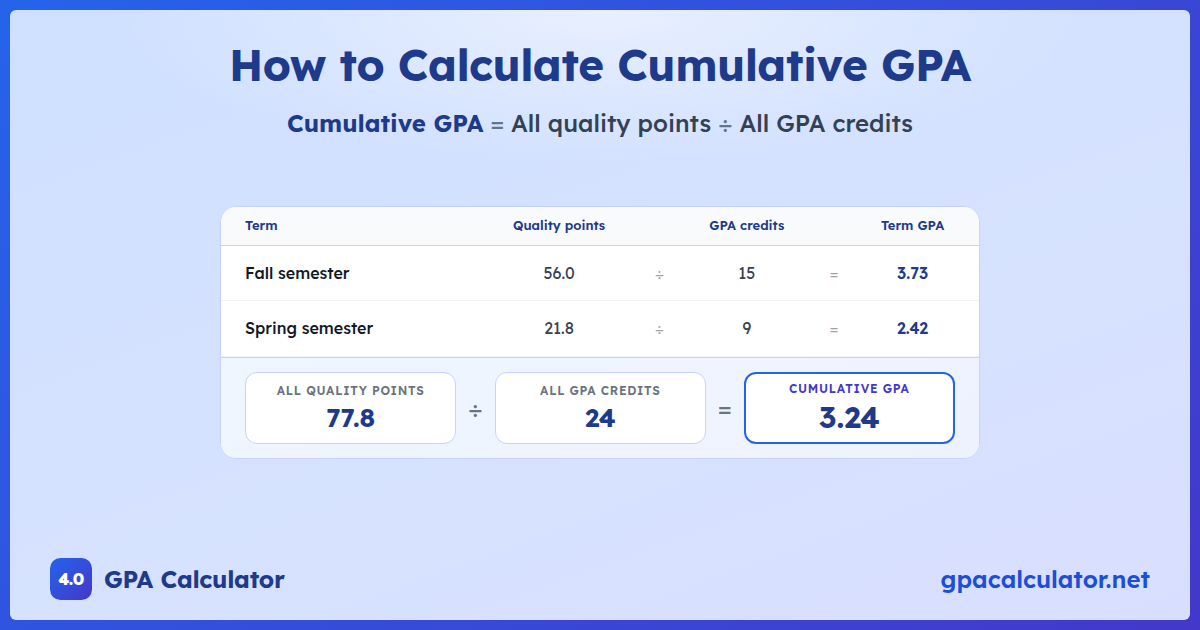
Cumulative GPA is your grade point average across every term you have completed, not only the last. Add the quality points from all graded courses, then divide by your total GPA credits. Your transcript keeps it as a running total.
Cumulative GPA = All quality points ÷ All GPA credits
Quality points
Grade points × credits, for every graded course in every term.
GPA credits
Credits from letter-graded courses, including any F.
On this page · 6 sections
Cumulative GPA vs. semester GPA
Your semester (or term) GPA covers one term. Your cumulative GPA covers every graded course you have taken at your school, so it is the number that follows you.
| What differs | Semester GPA | Cumulative GPA |
|---|---|---|
| Courses included | One term | Every term so far |
| You divide by | That term’s credits | All credits to date |
| How much it moves | Can swing a lot | Moves less over time |
| Where it shows | Term grade report | Transcript, applications |
| Often used for | Dean’s list | Graduation, Latin honors |
Why you can’t average your semester GPAs
Each semester GPA hides how many credits stand behind it. Take the student whose first year you’ll follow through this guide: a 3.73 over 15 credits in the fall, then a 2.42 over 9 credits in the spring.
- Averaging the two GPAs gives (3.73 + 2.42) ÷ 2 ≈ 3.08.
- The real cumulative GPA is 77.8 quality points ÷ 24 credits ≈ 3.24.
The fall carried more credits, so it should count for more, and averaging the GPAs throws that away. A plain average only works when every term has exactly the same number of GPA credits. The next section shows how to do it the right way.
How to calculate cumulative GPA in 5 steps
Pull up your transcript or student portal, because you need every term’s grades and credits. You’ll learn the method once on the same student’s fall semester, and section 3 adds the spring.
| Course | Grade | Grade points | Credits | Quality points | |||
|---|---|---|---|---|---|---|---|
| English Composition | A | 4.0 | 3 | 12.0 | |||
| Calculus I | A– | 3.7 | 4 | 14.8 | |||
| Intro to Psychology | A | 4.0 | 3 | 12.0 | |||
| General Biology | B+ | 3.3 | 4 | 13.2 | |||
| Biology Lab | A | 4.0 | 1 | 4.0 | |||
Total quality points 56.0 Credits counted 15 GPA 3.73 | |||||||
- Convert each letter grade to grade points. Use your school’s scale, or the standard 4.0 scale in section 4. The student’s A− in Calculus I is worth 3.7.
- Calculate quality points for each course. Multiply the grade points by the course’s credits: 3.7 × 4 credits = 14.8.
- Total your quality points. Add every course in every term. The student’s five fall courses come to 56.0.
- Total your GPA credit hours. Add the credits of every letter-graded course, F grades included, and leave out pass/fail, withdrawals and incompletes (section 5). The fall adds up to 15.
- Divide quality points by credits. 56.0 ÷ 15 ≈ 3.73. Round to two decimals, unless your school truncates (cuts off the extra digits).
Common mistake
Dividing by the number of courses instead of the credits. That only works when every course has the same credits. Always divide by credits.
The fall is only half of this student’s year, though.
Cumulative GPA example: a sample transcript
Your fall left you with 56.0 quality points over 15 credits. The spring was lighter but tougher: three courses and 9 credits.
| Course | Grade | Grade points | Credits | Quality points | |||
|---|---|---|---|---|---|---|---|
| Calculus II | C | 2.0 | 4 | 8.0 | |||
| General Chemistry | B– | 2.7 | 4 | 10.8 | |||
| First-Year Seminar | B | 3.0 | 1 | 3.0 | |||
Total quality points 21.8 Credits counted 9 GPA 2.42 | |||||||
To combine the terms, add both totals and divide once:
Cumulative GPA = (56.0 + 21.8) ÷ (15 + 9) = 77.8 ÷ 24 = 3.2416… ≈ 3.24
Quick check
Say this student adds a 3-credit summer class and earns an A. What is the new cumulative GPA?
Answer
The A adds 4.0 × 3 = 12 quality points and 3 credits: (77.8 + 12) ÷ (24 + 3) = 89.8 ÷ 27 ≈ 3.33.
Each new term works the same way: add its quality points to 77.8 and its credits to 24, then divide again. Every one of those sums starts with turning letters into points.
Grade conversion scale for cumulative GPA
If your school doesn’t publish its own scale, use this one for step 1. Most U.S. schools start from it.
| Band | Letter grade | % range | Grade points |
|---|---|---|---|
| Excellent | A+ | 97–100 | 4.0 |
| A | 93–96 | 4.0 | |
| A− | 90–92 | 3.7 | |
| Good | B+ | 87–89 | 3.3 |
| B | 83–86 | 3.0 | |
| B− | 80–82 | 2.7 | |
| Average | C+ | 77–79 | 2.3 |
| C | 73–76 | 2.0 | |
| C− | 70–72 | 1.7 | |
| Low pass | D+ | 67–69 | 1.3 |
| D | 63–66 | 1.0 | |
| D− | 60–62 | 0.7 | |
| Fail | F | Below 60 | 0.0 |
Your school’s own values always win. Some colleges skip plus and minus grades, and a few give an A+ more than 4.0, so use the scale printed in your catalog or on your transcript key. Some grades never reach the scale at all.
Special cases and course types
Not every grade on your transcript goes into the math. The table shows how the common exceptions usually work, and real school rules follow it.
| Grade or course | Quality points | In GPA credits? |
|---|---|---|
| Repeated course | Varies by school | Replaced, or both count |
| Pass (P, S, CR) | None | No |
| Incomplete (I) | None for now | Not until a grade is posted |
| Withdrawal (W) | None | No |
| Transfer credit | Varies by school | Varies by school |
| AP or IB exam credit | None unless a grade is posted | No |
Repeated courses
At the University of Memphis, the first attempt drops out of your cumulative GPA and the second and later attempts count. Schools without a replacement rule keep both grades in, so check your catalog before you retake a class.
Pass/fail, incomplete and withdrawal grades
Memphis leaves CR and NC (credit and no credit) grades out of GPA, and a W doesn’t affect it either. A W still counts as credits you attempted, and some scholarships limit those.
Warning
An incomplete can turn into an F. At Memphis you have until the end of the next fall or spring term to finish the work; after that the I becomes an F, which counts as 0.0 in your GPA.
Transfer credits
Some colleges post transfer courses as credit only, so their grades stay out of your GPA. Others count them: Memphis counts most transfer work in its overall GPA, and John Jay College averages your earlier colleges’ GPA with its own when it decides Latin honors.
AP and weighted high school courses
High schools that weight grades add a boost for Honors, AP or IB classes, often 0.5 or 1.0 point, so a weighted cumulative GPA can top 4.0. Colleges may recalculate it their own way: the University of California counts only its required college-prep (A–G) courses from 10th and 11th grade, with extra Honors, AP or IB points for at most eight semesters (no more than four from 10th grade).
In college, AP exam credit usually counts toward your degree, but credit without a posted grade adds nothing to your quality points or GPA credits. Once you know which grades count, you can plan how to move your own number.
Strategies to raise your cumulative GPA
Your cumulative GPA rises only when new grades beat your current average, and the more credits you have, the more new credits it takes to move.
How many A credits it takes
To find the credits you need at a given grade, use: credits needed = current credits × (target − current GPA) ÷ (new grade points − target).
The same student now has a 3.24 over 24 credits. To reach 3.50 with straight A’s: 24 × (3.50 − 3.2416) ÷ (4.0 − 3.50) = 12.4, so 13 credits of A’s. Starting from a 3.0, it looks like this:
| Credits completed at 3.0 | A credits to reach 3.3 | A credits to reach 3.5 |
|---|---|---|
| 30 | 13 | 30 |
| 60 | 26 | 60 |
| 90 | 39 | 90 |
Grades at or below your target can never get you there, however many credits you take. A B (3.0) can’t lift a 3.0 GPA at all.
Ways to move it faster
- Act early. A 15-credit semester of A’s would lift this student to 137.8 ÷ 39 ≈ 3.53 now, but only to about 3.35 after 90 credits at the same 3.24.
- Retake a low grade if your school replaces it. Replacing the C in Calculus II with a B adds 4 quality points and no credits: 81.8 ÷ 24 ≈ 3.41. A brand-new 4-credit A only reaches 93.8 ÷ 28 ≈ 3.35.
- Put your effort where the credits are. A B instead of a C in 4-credit Calculus II adds 4 quality points; the same jump in the 1-credit seminar adds only 1.
- Withdraw before an F, if the deadline allows. An F in General Chemistry would have left this student at 67.0 ÷ 24 ≈ 2.79. A W keeps the course out: 67.0 ÷ 20 = 3.35.
The Raise GPA Calculator, in Keep planning at the end of this page, runs this math with your own GPA, credits and target.
Frequently asked questions
What cumulative GPA do you need to graduate?
Your college’s catalog sets the minimum cumulative GPA for a degree, and some majors set a higher one, so check both. Separately, federal student aid requires at least a C average, or your school’s equivalent, by the end of your second academic year.
What GPA do you need for Latin honors?
Each college sets its own cutoffs. At John Jay College, cum laude takes a 3.5 cumulative GPA, magna cum laude 3.75 and summa cum laude 3.9, and you must complete at least 56 credits there. Other schools use different numbers.
Do all colleges calculate cumulative GPA the same way?
No. Schools differ on plus and minus values, whether a retake replaces the first grade, and whether transfer grades count. Colleges reviewing applications may also recalculate your GPA from scratch, as the University of California does.
Does a W lower your cumulative GPA?
Usually not. A withdrawal carries no grade points and no GPA credits, so the math ignores it. It can still count against limits on attempted hours, which some scholarships and aid programs track.
Is cumulative GPA the same as overall GPA?
Usually, yes: both mean the GPA for all your graded courses. Some transcripts show more than one, such as an institutional GPA for courses taken at that school and a combined GPA that adds transfer work.
Sources
- Grading Scale and GPAUniversity of Memphis Registrar
- Graduating with Latin HonorsJohn Jay College of Criminal Justice, CUNY
- GPA RequirementUniversity of California Admissions
- 34 CFR 668.34: Satisfactory Academic ProgressElectronic Code of Federal Regulations