Pick any one. The other two follow.
On this page · 6 sections
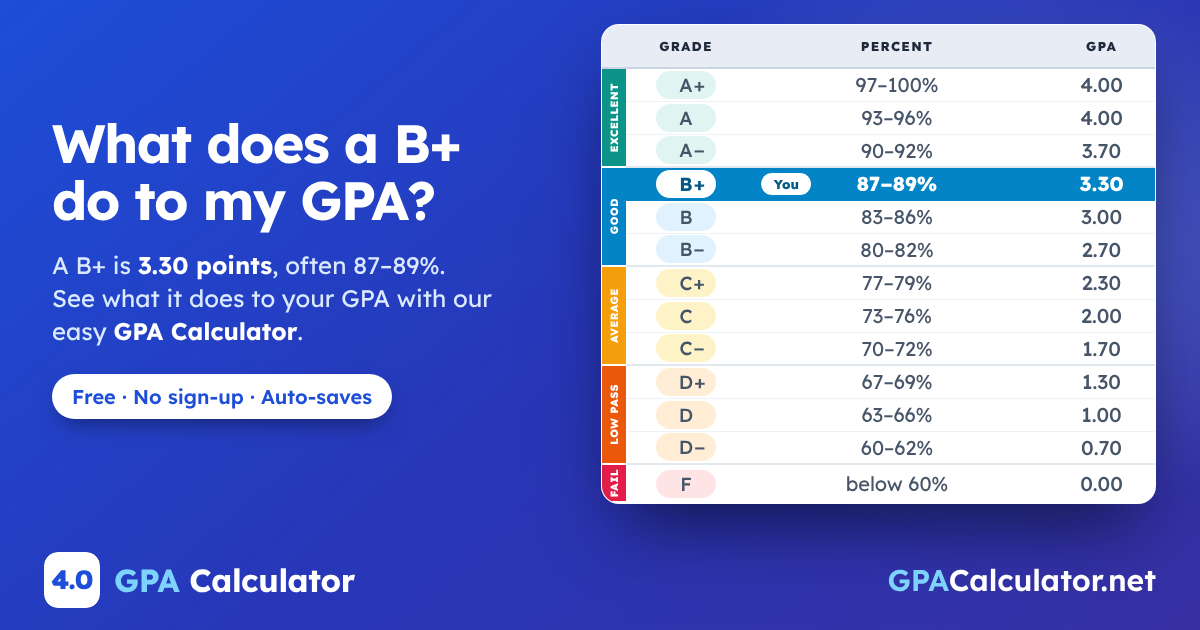
| Band | Letter grade | % range | Grade points |
|---|---|---|---|
| Excellent | A+ | 97–100% | 4.0 |
| A | 93–96% | 4.0 | |
| A− | 90–92% | 3.7 | |
| Good | B+ | 87–89% | 3.3 |
| B | 83–86% | 3.0 | |
| B− | 80–82% | 2.7 | |
| Average | C+ | 77–79% | 2.3 |
| C | 73–76% | 2.0 | |
| C− | 70–72% | 1.7 | |
| Low pass | D+ | 67–69% | 1.3 |
| D | 63–66% | 1.0 | |
| D− | 60–62% | 0.7 | |
| Fail | F | Below 60% | 0.0 |
Have a B+? Find your next move
Only the final exam left?
Use your current course percentage, the final exam’s weight and your target to find the exam score you need. This is for a course still in progress.
Open the Final Grade Calculator if your final exam is the only work left. Enter your grade now, the final’s weight and your goal. It shows the exam score you need.
Find your current grade
Use your exact percentage before the final. An 88.6% is more useful than just “B+.”
Check the final’s weight
Find the percentage in your syllabus. A final worth 20% means you enter 20.
Choose your next goal
Choose B+ to protect it, or A− to aim higher. Use Exact % if your course has different cutoffs.
Mid-semester: assignments still left?
Use the Grade Calculator to work out your course average and try possible scores for remaining homework, quizzes, exams or projects. Enter the weights from your syllabus.
In the final calculator, choose Exact % to match your syllabus. A letter-grade input is an estimate; use your actual percentage whenever you have it.
From B+ to A−: what would it take?
Suppose you have 88%, your final is worth 20%, and your course’s A− cutoff is 90%. Here are three possible goals:
| Your goal | Course cutoff | Final score needed |
|---|---|---|
| Keep a B+ | 87% | 83% |
| Reach an A− | 90% | 98% |
| Reach an A | 93% | 113% — above a 100% exam maximum |
Why the answer is 98%
Your current work contributes 70.4 points: 88 × 0.80.
You need another 19.6 points to reach 90. A final worth 20% must score 98%: 19.6 ÷ 0.20.
If your target is out of reach, try the next attainable grade. Check for an announced dropped-test or replacement policy before relying on the result.
What percentage is a B+?
On the example scale used here, a B+ is 87% to less than 90%. That includes 89.9% before any rounding. Your syllabus decides the actual cutoffs.
| Letter grade | Example percentage range | Example GPA points |
|---|---|---|
| A− | 90% to less than 93% | 3.70 |
| B+ | 87% to less than 90% | 3.30 |
| B | 83% to less than 87% | 3.00 |
Close to the boundary?
An 86.4% does not round to 87% under ordinary nearest-whole-number rounding. An 89.5% reaches 90% only if your course applies that rounding rule. Check the policy before counting on a higher letter.
See the grade chart for the full example scale.
How many GPA points is a B+?
A B+ is worth 3.30 on many plus/minus scales, but the value is not universal. The registrar is the office that publishes your school’s official letter-to-GPA conversion.
| Published school scale | B+ value |
|---|---|
| Stanford — general university scale | 3.30 |
| University of Iowa | 3.33 |
| Georgia Tech | B+ is not listed; B is 3.00 |
What about honors or AP? If your high school adds 0.5 points to a 3.30 B+, it becomes 3.80; a 1.0 boost makes it 4.30. Those are conditional examples, not automatic bonuses. Check which courses qualify and whether your school uses plus/minus grades.
What will one B+ do to my GPA?
A B+ raises a GPA below its point value and lowers one above it. The size of the change depends on the course’s credits and how many GPA credits you already have.
One class, a small change
Starting GPA: 3.60 over 45 GPA credits.
New class: a 3-credit B+ worth 3.30.
New GPA: 3.58 — down about 0.02.
| Step | Calculation |
|---|---|
| Your existing grade points | 3.60 × 45 = 162 |
| Add the B+ course | 3.30 × 3 = 9.90 |
| Divide by all GPA credits | 171.90 ÷ 48 = 3.58125 → 3.58 |
Use credits included in your GPA, not every credit on your transcript. Do not add the course twice if it is already in your starting GPA.
Already received your final course grade?
Use the GPA Calculator to combine this grade with your other course grades and credits. It calculates your semester or cumulative GPA—not the percentage within this one class. If your starting GPA already includes this course, do not add it again.
Already have a 3.3 cumulative GPA? Read what a 3.3 GPA means for the bigger picture across all your classes.
B+ grade questions
What percentage is a B+?
On the example scale used here, B+ starts at 87% and ends just below 90%. Your course may use different boundaries or rounding rules, so check your syllabus.
Can I raise an 88% to an A− on the final?
Yes, in this example: if the final is worth 20% and A− starts at 90%, you need 98% on the final. This assumes the final is the only work left and there are no special grading rules.
Does an 89.5% round up to an A−?
Only if your course’s policy rounds it to 90% and uses 90% as the A− cutoff. Some instructors keep decimals or do not round at all.
Is a B+ a 3.3 or a 3.33?
Both exist. Stanford’s general scale assigns B+ 3.3, while the University of Iowa assigns it 3.33. Use the grading scale that applies to your course and program.
How much does one B+ lower a 4.0?
With a 4.00 GPA over 30 GPA credits, adding a 3-credit B+ worth 3.30 gives a new GPA of about 3.94. More completed credits reduce the effect of one class.
Is a B+ a good grade?
A B+ sits above B and below A− on a plus/minus scale. Whether it meets your goal depends on the course and any program requirements. If work remains, calculate the score needed for your next target before deciding where to focus.