Your GPA is the one number that follows you from your first report card to college applications, scholarships and even your first job. GPA stands for grade point average: it turns all your letter grades into a single score, usually on a 4.0 scale, where an A is worth 4 points and an F is worth 0.
This guide covers what your GPA means, how it’s worked out, what counts as a good one and how to raise it, with the real cutoffs that scholarships and colleges use and the myths you can safely ignore.
On this page · 8 sections
GPA meaning: what does GPA stand for?
The name tells you how it works: every final grade earns grade points, and your GPA is simply the average of those points. That’s why a college, a scholarship committee or an employer can read your whole record at a glance.
It isn’t the same as a percentage grade. Your percentage shows how much of a class’s work you got right. Your GPA only looks at each class’s final letter, so a 93% and a 99% both count as an A, worth 4.0 on most scales.
You’ll usually come across four kinds of GPA:
- Term or semester GPA: the classes from one grading period only.
- Cumulative GPA: every graded class you’ve taken at your school, all terms together. This is the number most people mean by “my GPA”.
- Major GPA: only the classes in your major, which some departments check before you can declare it or graduate.
- Weighted GPA: a high school GPA that gives extra points for Honors, AP or IB classes (more on that in section 4).
Whichever one you’re looking at, they all start in the same place: the points each letter grade is worth.
GPA scale: how grades become points
Most US high schools and colleges use a 4.0 scale. An A is worth 4 points, a B 3, a C 2, a D 1 and an F 0, with plus and minus grades in between. Here’s the standard version with typical percent ranges:
| Letter grade | % range | Grade points |
|---|---|---|
| A+ | 97–100 | 4.0 |
| A | 93–96 | 4.0 |
| A− | 90–92 | 3.7 |
| B+ | 87–89 | 3.3 |
| B | 83–86 | 3.0 |
| B− | 80–82 | 2.7 |
| C+ | 77–79 | 2.3 |
| C | 73–76 | 2.0 |
| C− | 70–72 | 1.7 |
| D+ | 67–69 | 1.3 |
| D | 63–66 | 1.0 |
| D− | 60–62 | 0.7 |
| F | Below 60 | 0.0 |
Your school sets its own version, so it’s worth a quick look at your handbook or course catalog. Three differences come up a lot:
- Plus and minus grades. Some schools only use whole letters, so a B+ and a B− both count as 3.0.
- The A+. Most schools cap an A+ at 4.0, but a few count it as 4.3.
- Percent cutoffs. One school’s B starts at 80%, another’s at 83% or 85%.
Not every GPA is out of 4.0, either. Weighted high school GPAs often go up to 5.0, and many countries use their own systems, like the 10-point scale used at many universities in India. Our GPA scale guide lines up the common scales and explains what each GPA from 1.0 to 4.0 means.
Once you know what each grade is worth, working out your GPA is simple math.
How GPA is calculated
Your GPA is an average, but one where bigger classes count more. It takes three steps:
- Turn each grade into points using the scale above, or your school’s own values.
- Multiply the points by the class’s credits. This gives you quality points: a B (3.0) in a 4-credit class is worth 12.
- Add up your quality points and divide by your total credits.
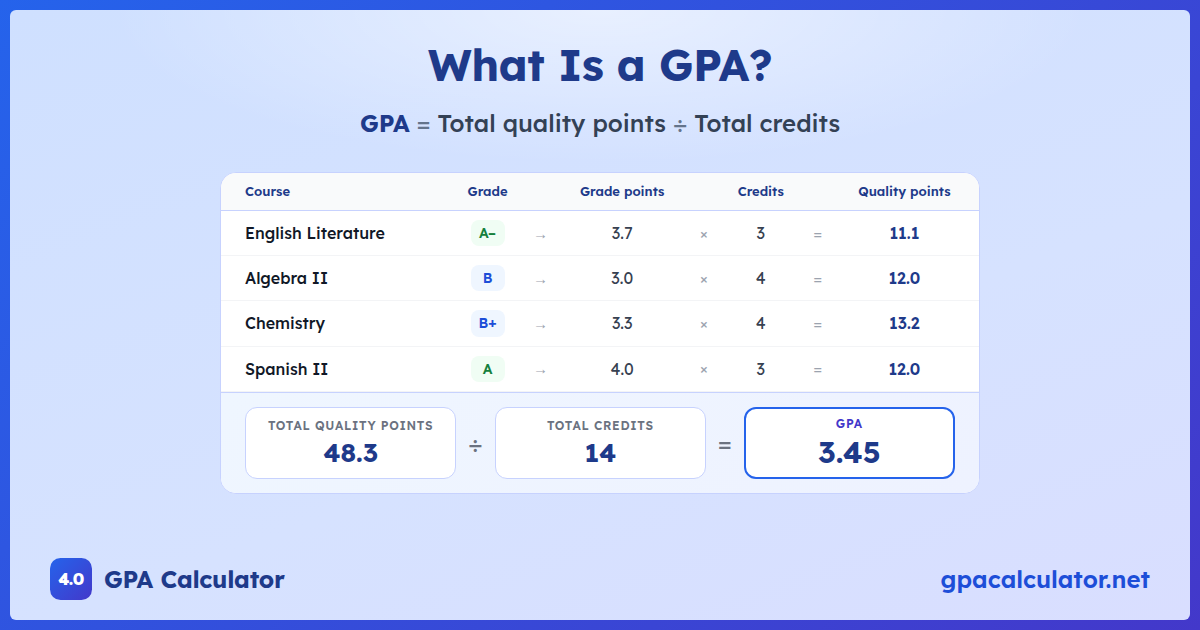
GPA = Total quality points ÷ Total credits
Here’s how that works for a term with four classes and 14 credits:
| Course | Grade | Grade points | Credits | Quality points | |||
|---|---|---|---|---|---|---|---|
| English Literature | A– | 3.7 | 3 | 11.1 | |||
| Algebra II | B | 3.0 | 4 | 12.0 | |||
| Chemistry | B+ | 3.3 | 4 | 13.2 | |||
| Spanish II | A | 4.0 | 3 | 12.0 | |||
Total quality points 48.3 Credits counted 14 GPA 3.45 | |||||||
Notice how the two 4-credit classes pull the most weight. A plain average of the four grades, (3.7 + 3.0 + 3.3 + 4.0) ÷ 4 = 3.50, would come out too high here. If all your classes carry the same credit, as in many high schools, the plain average is the right answer. Schools also differ on rounding: some show 3.456 as 3.46, others cut it to 3.45, so a 0.01 gap with your transcript is normal.
Withdrawals and incompletes usually stay out of the math, while an F counts as 0 points with its full credits. For step-by-step help with unweighted, weighted, semester and cumulative GPA, plus GPA scales and high school vs. college, see our full guide on how to calculate GPA.
Rather skip the math? Enter your classes, grades and credits, and our calculator works out your GPA for you, weighted or unweighted.
That’s the standard, or unweighted, GPA. Many high schools also report a second number that rewards harder classes.
Weighted vs. unweighted GPA
An unweighted GPA treats every class the same. An A is 4.0 whether it’s in PE or AP Calculus, so 4.0 is the top. A weighted GPA gives a bonus for harder classes, so it can go above 4.0.
Many weighted scales add half a point for Honors classes and a full point for AP, IB and dual-enrollment classes, though your high school decides the exact boost. Here’s what each grade is worth at each level on a typical scale:
Example
You take five classes and earn an A in AP Biology, a B in AP History and A’s in three regular classes.
Unweighted: (4 + 3 + 4 + 4 + 4) ÷ 5 = 3.80
Weighted: the AP grades become 5.0 and 4.0, so (5 + 4 + 4 + 4 + 4) ÷ 5 = 4.20
Because every high school weights a little differently, many colleges recalculate your GPA their own way. The University of California, for example, uses only its required A–G courses from 10th and 11th grade, and adds an extra point for up to eight semesters of approved Honors, AP or IB courses, with no more than four from 10th grade. So when an application asks, list both numbers, and use your unweighted GPA to compare yourself with students from other schools.
Weighted or not, the next question is the one everyone asks: is your GPA a good one?
What is a good GPA?
In short, a good GPA is one at or above the average of the students you’re compared with. Across the US, that average has been climbing:
That makes a 3.0 about average, a 3.5 a clear step above and a 3.8 or higher well above the national average. Here’s how unweighted GPAs usually read:
| Average grade | Unweighted GPA | What it means |
|---|---|---|
| A− to A | 3.7–4.0 | Top of class |
| B+ | 3.3–3.6 | Well above average |
| B | 3.0–3.2 | About average |
| C to B− | 2.0–2.9 | Below average |
| D or lower | Below 2.0 | Below most minimums |
“Good” also depends on what you’re aiming for. A GPA that’s fine for one college can fall short at a more selective one. And colleges look at the classes behind the number: a 3.6 with several AP courses can be stronger than a 3.9 with none. To see where you stand, look up the typical GPA of admitted students at each school on your list. Many colleges publish it in their Common Data Set, and it tells you more than any national average.
Some goals go further and set a hard minimum. That’s where your GPA starts to really matter.
GPA requirements for college and scholarships
Your GPA is often the first number a decision maker sees, and many of them set a cutoff. Colleges read your grades before almost anything else, scholarships use your GPA to decide who qualifies and who keeps the money, and even federal student aid has a GPA rule. Here are some common minimums:
| Program | Minimum GPA | What counts |
|---|---|---|
| Federal student aid | 2.0 | C average by the end of year two |
| NCAA Division I | 2.3 | High school core courses |
| UC, California residents | 3.0 | A–G courses, grades 10–11 |
| UC, nonresidents | 3.4 | A–G courses, grades 10–11 |
| Georgia HOPE Scholarship | 3.0 | High school, then each college checkpoint |
| Florida Academic Scholars | 3.5 | Weighted high school GPA |
| Florida Medallion Scholars | 3.0 | Weighted high school GPA |
The cutoffs don’t stop once you’re in college, either. Your school uses your GPA for good standing, academic probation, the dean’s list and graduation honors, and graduate, law and medical schools ask for your college GPA, often with a stated minimum. Some employers ask for it too, especially for internships and first jobs.
Warning
Most scholarships check your GPA again before they renew, so a slipping GPA can cost you the award. Check the renewal rule as soon as you win one.
Common GPA myths
With this much riding on one number, it’s no surprise that a few myths get passed around. Here’s the truth behind the ones we hear most.
| Myth | What’s true |
|---|---|
| My high school GPA carries over to college. | Your college GPA starts from zero. Your high school GPA still counts for admission and scholarships, but it never mixes into your college average. |
| Pass/fail classes drag your GPA down. | A pass adds credits but no grade points, so it usually doesn’t count at all. Check your school’s policy, since a failing grade is sometimes counted. |
| Retaking a class erases the old grade. | Many colleges let the new grade replace the old one in your GPA, but both usually stay on your transcript. Medical, PA and law school applications (AMCAS, CASPA and LSAC) count every attempt that shows on your transcript, even when your college replaces the grade. |
| Transfer credits will raise my GPA. | At many colleges they count toward your degree but not your GPA, which only includes that school’s classes. |
| GPA is all that matters. | It doesn’t show how hard your classes were or what you did outside class, so applications also ask for essays and activities. |
| One bad semester ruins your GPA for good. | A rough term hurts most early on, when you have few credits, and that’s also when it’s easiest to bounce back. |
That last one is good news, because it means you can almost always pull your GPA up.
How to raise your GPA
You raise your GPA by earning grades above your current average, and the sooner you start, the more each grade counts. Every new credit is averaged in with all your old ones, so the more credits you have, the harder your GPA is to move.
Here’s how far 15 credits of straight A’s lift a 3.0 GPA, depending on when they come:
| Credits so far | New GPA |
|---|---|
| 30 | 3.33 |
| 60 | 3.20 |
| 90 | 3.14 |
The same A’s do less each year, so start now. These three habits help the most:
- Focus on high-credit classes. Raising a 4-credit class from a C to a B adds as many quality points as raising four 1-credit classes by the same step.
- Protect the small points. Missed homework and skipped quizzes add up faster than one hard exam. Office hours and tutoring early in the term catch problems before the final.
- Balance your schedule. Pair your toughest class with ones you feel confident in, instead of stacking them all in one term.
Tip
Watch the withdrawal deadline. If a class is going badly, dropping it before the deadline usually keeps it out of your GPA.
Want to know exactly what grades you need to hit a target? Try the Raise GPA Calculator, then come back to this guide whenever your grades change.
Key takeaways
- GPA stands for grade point average: your grades turned into one number, usually on a 4.0 scale.
- It’s your total quality points divided by your total credits, so classes with more credits count more, and a weighted GPA can go above 4.0.
- The average US high school graduate had a 3.11 GPA in 2019, and common scholarship and aid cutoffs run from 2.0 to 3.5.
- Good grades early on move your GPA the most, and it’s almost never too late to raise it.
Frequently asked questions
What does a 4.0 GPA mean?
A 4.0 means you earned an A in every class, the top of the unweighted scale. On a weighted scale it can mean a mix of A’s and B’s in Honors or AP classes, so check which kind it is.
What’s the difference between GPA and class rank?
Your GPA measures your own grades, while class rank compares your GPA with everyone else’s in your grade, such as 25th out of 300. Not every high school reports a rank, so colleges often rely on your GPA and the classes behind it.
When does your GPA start counting?
Your high school GPA starts with your first high school classes, usually in 9th grade, and middle school grades rarely count. Some colleges use fewer years: the University of California, for example, recalculates GPA from 10th and 11th grade courses only.
Is CGPA the same as GPA?
CGPA means cumulative grade point average, so it is a GPA covering every term so far. The term is common in India and other countries where it often uses a 10-point scale instead of 4.0.
How do I find out my GPA?
Your official GPA is on your transcript or in your school’s student portal, usually updated after each grading period. Between reports, you can work it out from your current grades and credits with a GPA calculator.
Sources
- Results From the 2019 NAEP High School Transcript StudyNational Center for Education Statistics
- GPA RequirementUniversity of California Admissions
- 34 CFR 668.34: Satisfactory Academic ProgressElectronic Code of Federal Regulations
- NCAA Division I Initial Eligibility RequirementsNCAA Eligibility Center
- HOPE Scholarship: Frequently Asked QuestionsGeorgia Student Finance Commission
- Florida Bright Futures Scholarship Program: Academic and Medallion ScholarsFlorida Office of Student Financial Assistance
- Grades Factored Into AMCAS GPA CalculationsAssociation of American Medical Colleges
- Calculating Your CASPA GPAsLiaison International (CASPA)
- Transcript SummarizationLaw School Admission Council