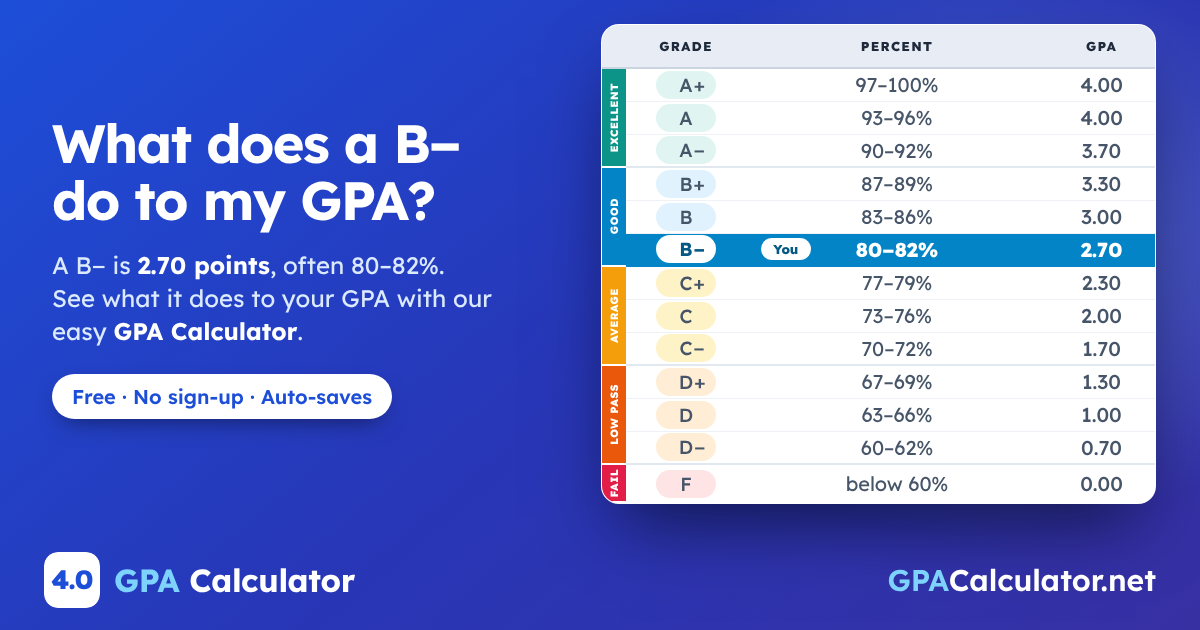
Pick any one. The other two follow.
On this page · 6 sections
| Band | Letter grade | % range | Grade points |
|---|---|---|---|
| Excellent | A+ | 97–100% | 4.0 |
| A | 93–96% | 4.0 | |
| A− | 90–92% | 3.7 | |
| Good | B+ | 87–89% | 3.3 |
| B | 83–86% | 3.0 | |
| B− | 80–82% | 2.7 | |
| Average | C+ | 77–79% | 2.3 |
| C | 73–76% | 2.0 | |
| C− | 70–72% | 1.7 | |
| Low pass | D+ | 67–69% | 1.3 |
| D | 63–66% | 1.0 | |
| D− | 60–62% | 0.7 | |
| Fail | F | Below 60% | 0.0 |
What a B− means
A B− is the lowest grade in the B band on this example chart. It usually converts to 2.70 on a scale using tenths, but some schools use 2.67. The percentage that earns it comes from your course’s grading policy.
What would it take to move from B− to B?
If your syllabus puts B at 83%, moving from 81% to B means gaining two points in your overall course average. With a final worth 25%, you need an 89% final—not just an 83%. Your earlier work still counts for the other 75%.
Use your exact current percentage, the final exam’s weight and the course percentage you want. Choose Exact % when your syllabus uses different cutoffs. This calculation assumes the final is the only work remaining.
Only the final exam left?
Use your current course percentage, the final exam’s weight and your target to find the exam score you need. This is for a course still in progress.
| Goal | Example course cutoff | Final score needed |
|---|---|---|
| Keep B− | 80% | 77% |
| Reach B | 83% | 89% |
| Reach B+ | 87% | 105% — above a 100% maximum |
How the calculation works
Required final score = [target − (81 × 0.75)] ÷ 0.25. For a 83% target, that is 89%.
Mid-semester: assignments still left?
Use the Grade Calculator to work out your course average and try possible scores for remaining homework, quizzes, exams or projects. Enter the weights from your syllabus.
What percentage is a B−?
On this example scale, B− runs from 80% up to, but not including, 83%. The chart above uses whole-number labels for readability. A score of 82.9% stays in this band before any permitted rounding.
Percentage cutoffs decide the course letter; GPA points decide how that letter enters your GPA. These are separate rules. The school’s registrar publishes the GPA scale, while your syllabus explains course weights, cutoffs and rounding.
Do not count on an automatic round-up
If your course rounds to the nearest whole percent, 82.5% can round to 83%. If it keeps decimals or does not round, it does not. A calculator cannot grant a grade change that your course policy does not allow.
Does a B− meet a B-or-better requirement?
No, if the requirement literally asks for B or better, B− is below it. If the rule instead asks for a 3.00 cumulative GPA, one B− does not automatically make you ineligible: you need to calculate the average across the relevant courses.
Check the exact wording before planning around a threshold. A minimum course grade, minimum term GPA and minimum cumulative GPA are three separate conditions. Also check whether the school rounds or truncates the GPA used for that decision.
| What you need to know | Where to check |
|---|---|
| Does the course earn credit? | School catalog and transcript legend |
| Does it satisfy this prerequisite or major course? | Specific course listing and program requirements |
| Will another school accept it? | Receiving school’s transfer evaluation |
| Must I repeat it? | Degree audit, adviser and repeat policy |
How many GPA points is a B−?
| Published scale | B− value |
|---|---|
| Stanford general university scale | B− = 2.70 |
| University of Iowa | B− = 2.67 |
For Stanford courses, use the Stanford GPA Calculator. For another institution, find your school in the college GPA calculators or enter its published point values.
For weighted high-school courses, check which classes qualify for a bonus and which grades receive it. Do not automatically add honors or AP points to the college values above.
What will one B− do to your GPA?
Suppose your current GPA is 3.05 over 40 GPA credits, and you add a 4-credit B− worth 2.70. Your new GPA is 3.02. This assumes the course is not already in your starting GPA.
The calculation
(3.05 × 40 + 2.70 × 4) ÷ 44 = 3.0182, or 3.02 rounded to two decimals.
Use credits included in your GPA, which may differ from total earned credits. The button below opens the GPA Calculator for your own course grades.
Already received your final course grade?
Use the GPA Calculator to combine this grade with your other course grades and credits. It calculates your semester or cumulative GPA—not the percentage within this one class. If your starting GPA already includes this course, do not add it again.
If you plan to retake a course already on your transcript, use the Course Repeat GPA Calculator with your school’s policy. For your overall average, read what a 2.7 GPA means.
Frequently asked questions
What percentage is a B−?
80% to less than 83% on this example chart. Your syllabus determines the actual cutoffs and rounding policy.
Will one B− put me below a 3.0 GPA?
It depends on your starting GPA and credits. A 4-credit B− worth 2.70 added to a 3.05 over 40 GPA credits gives about 3.02. The same course added to a 3.02 over 20 credits gives about 2.97.
What do I need on my final to improve a B−?
It depends on your current percentage, final weight and target. With 81% before a final worth 25%, reaching 83% requires about 89% on the final. The example assumes no other work remains.
Can I calculate this from just my letter grade?
Only as an estimate. A letter covers a range of percentages. Enter your exact gradebook percentage for a useful final-exam target, and check how ungraded work is treated.
Does rounding my GPA change my course grade?
No. GPA rounding and course-percentage rounding are separate policies. A displayed GPA does not change the letter your instructor awards.