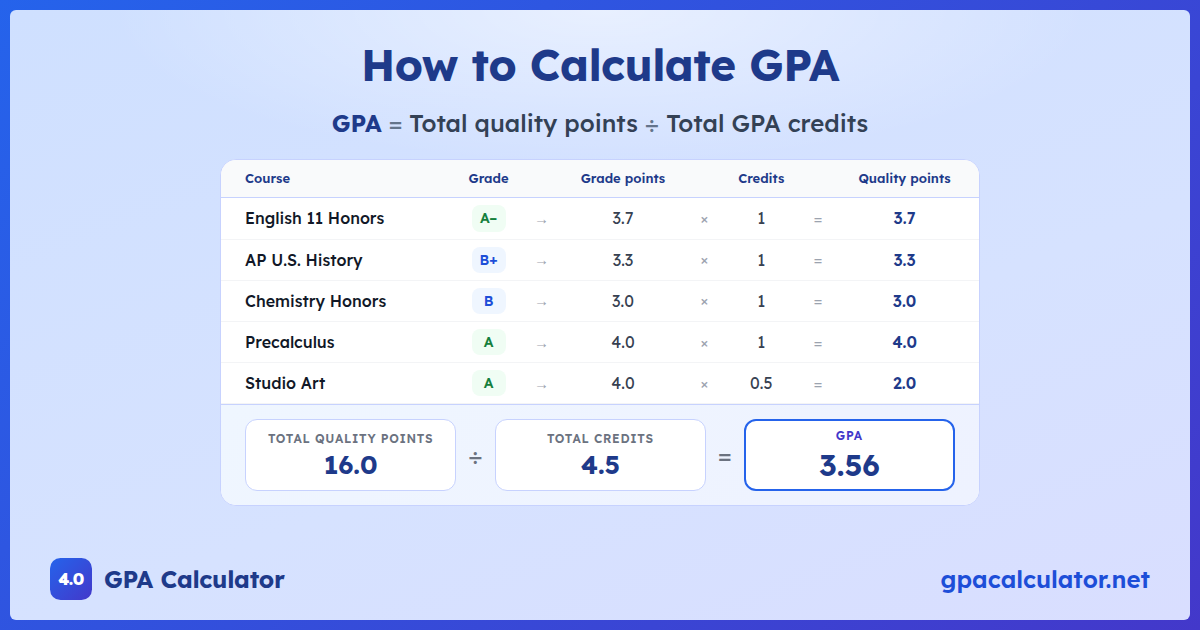
Whichever GPA you’re after, it comes down to one division:
GPA = Total quality points ÷ Total GPA credits
Grade points
What each letter is worth, like 4.0 for an A or 3.0 for a B.
Quality points
A class’s grade points × its credits.
GPA credits
Credits from every letter-graded class, F included.
Which GPA do you need? That depends on what you’re using it for.
- Applying to college or for a scholarship? Applications often ask for both your unweighted and weighted GPA, exactly as your school reports them.
- Just got a report card? Your semester GPA covers that one term.
- Looking at your whole record? That’s your cumulative GPA, which adds every term together.
- Comparing two GPAs? Check the scale behind each one first.
On this page · 6 sections
How to calculate unweighted GPA
Say your fall report card from junior year just came in. Start with your unweighted grade point average, where every class counts on the same 4.0 scale, AP or not. This page follows that one report card all the way through, so each section builds on the numbers you work out here.
- Turn each letter into grade points. On the usual scale an A is 4.0, an A− 3.7, a B+ 3.3 and a B 3.0, on down to 0.0 for an F. Your school sets the percent cutoffs, and our grade chart lists every letter with its range.
- Multiply each class’s grade points by its credits. The result is that class’s quality points.
- Add up the quality points, add up the credits, and divide the first total by the second.
Run your five graded classes through those steps:
| Class | Grade (points) | Credits | Quality points |
|---|---|---|---|
| English 11 Honors | A− (3.7) | 1.0 | 3.7 |
| AP U.S. History | B+ (3.3) | 1.0 | 3.3 |
| Chemistry Honors | B (3.0) | 1.0 | 3.0 |
| Precalculus | A (4.0) | 1.0 | 4.0 |
| Studio Art | A (4.0) | 0.5 | 2.0 |
| Total | 4.5 | 16.0 |
Divide and you get 16.0 ÷ 4.5 = 3.5556, which rounds to a 3.56 unweighted GPA. If your school truncates instead of rounding, your report card shows 3.55.
Common mistake
Averaging the five grade points skips the credits. That gives 18.0 ÷ 5 = 3.60, because Studio Art’s A counts as much as a 1-credit class. Weighted by credits, it counts half as much, and the real answer is 3.56.
That 3.56 treats every class the same. Three of yours, though, were Honors or AP, and many high schools give extra credit for that.
How to calculate weighted GPA
If your school weights grades, the change happens in step 1. You add a boost to each harder class’s grade points, then multiply, add and divide exactly as before. Many high schools add 0.5 for Honors and 1.0 for AP, IB or dual enrollment, which turns an AP A into a 5.0. Your handbook lists the boosts your school actually uses.
With those boosts, your three Honors and AP classes move up and the other two stay put:
| Class | Grade points + boost | Quality points |
|---|---|---|
| English 11 Honors | 3.7 + 0.5 = 4.2 | 4.2 |
| AP U.S. History | 3.3 + 1.0 = 4.3 | 4.3 |
| Chemistry Honors | 3.0 + 0.5 = 3.5 | 3.5 |
| Precalculus | 4.0 | 4.0 |
| Studio Art | 4.0 | 2.0 |
| Total | 18.0 |
Same 4.5 credits, same division: 18.0 ÷ 4.5 = 4.00 weighted. The whole gap between that and your 3.56 comes from three boosts.
Note
Some colleges redo the math with their own rules. The University of California, for example, counts approved college-prep classes from the summer after 9th grade through the summer after 11th grade. It drops pluses and minuses and adds one point per semester of an approved honors-level class, up to 8 points.
The weighted GPA guide has a full boost table and another worked example. Before moving on, though, look at your report card once more, because there’s a line you haven’t used yet.
How to calculate semester GPA
Below your five graded classes sits Health, a half-credit class you took pass/fail. Deciding which lines count is the real work in any semester GPA, and it comes down to how each class was graded. A P carries no grade points, so Health stays out of the math even though you earned its credit.
| Class | Grade | Credits earned | GPA credits |
|---|---|---|---|
| English 11 Honors | A− | 1.0 | 1.0 |
| AP U.S. History | B+ | 1.0 | 1.0 |
| Chemistry Honors | B | 1.0 | 1.0 |
| Precalculus | A | 1.0 | 1.0 |
| Studio Art | A | 0.5 | 0.5 |
| Health | P | 0.5 | None |
| Total | 5.0 | 4.5 |
You earned 5.0 credits, but only 4.5 go into the GPA, so your fall semester GPA stays 16.0 ÷ 4.5 = 3.56. Withdrawals and incompletes work like Health: a W or an I carries no grade points, and its credits stay out. An F is different. It earns 0 points, but its credits still count, so if Chemistry had been an F, your GPA would drop to 13.0 ÷ 4.5 = 2.89.
The semester GPA guide covers the rest, including how retakes are handled. One semester is only half the year, though.
How to calculate cumulative GPA
When spring grades arrive, you’ll want one number for the whole year. Resist the urge to average your two semester GPAs. Instead, add spring’s quality points and credits to fall’s totals, then divide once.
Say spring goes like this: an A in English, an A− in AP U.S. History, a B+ in Chemistry and an A− in Precalculus, each for 1 credit, plus a B in Psychology for 0.5 credit and an A in Computer Science for 1 credit.
- Spring: 20.2 quality points over 5.5 credits, a 3.67 for the term
- Year so far: 16.0 + 20.2 = 36.2 quality points over 4.5 + 5.5 = 10.0 credits
- Cumulative GPA: 36.2 ÷ 10.0 = 3.62
Averaging 3.56 and 3.67 lands close this time, because your two terms carry similar credits. Once one stretch of your record is much bigger than the other, an average drifts away from the real number.
Quick check
Your 9th- and 10th-grade years add up to a 3.20 over 12.0 credits. What’s your cumulative GPA once junior year’s 36.2 quality points over 10.0 credits are added?
Answer
3.20 × 12.0 = 38.4 past quality points. (38.4 + 36.2) ÷ (12.0 + 10.0) = 74.6 ÷ 22.0 = 3.39. Averaging 3.20 and 3.62 would give 3.41, which is too high.
The cumulative GPA guide walks through more examples, including rebuilding past quality points from a transcript that shows only a GPA.
GPA scales: 4.0, 4.3, 5.0 and others
Put your two fall numbers side by side, 3.56 and 4.00, and they look like two different students. They’re the same grades on two different scales. The division never changes; what each letter is worth does. These are the scales you’re most likely to run into:
| Scale | Top grade | Where you’ll see it |
|---|---|---|
| 4.0 unweighted | A = 4.0 | Most U.S. high schools and colleges |
| 4.3 or 4.33 | A+ = 4.3 or 4.33 | Colleges that reward an A+, such as Cornell (4.3) |
| 5.0 weighted | AP or IB A = 5.0 | High schools that boost advanced classes |
| Whole letters only | A = 4.0 | Schools without pluses or minuses, such as the University of Arizona |
So before you set your GPA next to a friend’s, a scholarship cutoff or a college’s average, make sure both numbers sit on the same scale. Our GPA scale guide lists every grade from A+ to F with its percent range, and has a page for each GPA from 1.0 to 4.0.
High school vs. college GPA
Heading to college soon? Everything you’ve done on this page works there too. What changes is the setup around the math.
Compare
High school
- Classes often carry equal credit, such as 1 per year-long class.
- Honors, AP and IB boosts are common, on a weighted scale.
- Read by colleges and scholarship programs.
College
- Credit hours vary by class, often from 1 to 5.
- Boosts are rare; an A is worth the same in every class.
- Read by graduation honors, grad schools and employers.
Picture your fall classes as college courses. Each might carry 3 or 4 credit hours, and the AP boost would disappear, so the credits would do far more of the work. Back in high school, if every class carries the same credit, you can skip the multiplying altogether: add the grade points and divide by the number of classes. The High School GPA Calculator handles both and shows your weighted and unweighted GPA together.
Frequently asked questions
What is a perfect GPA?
On the standard unweighted scale, a perfect GPA is 4.0: an A in every class. At schools that give an A+ 4.3 or 4.33, the top is 4.3 or 4.33. On a weighted scale, straight A’s in AP or IB classes can reach 5.0.
How do I convert a percentage grade to GPA?
Match the percent to a letter on your school’s scale, then use that letter’s grade points. On the common scale, an 88% is a B+ worth 3.3. If your school posts its own cutoffs, those win.
Do colleges look at weighted or unweighted GPA?
Often both. Give each number exactly as your school reports it. Colleges that recalculate start from the grades on your transcript, so converting it yourself doesn’t help.
Does a withdrawal lower my GPA?
Usually not. A W carries no grade points and its credits stay out of the GPA. It still appears on your transcript as a W.
Is an unweighted GPA the same as a 4.0-scale GPA?
Almost always. Unweighted means every class uses the same points, usually on the 4.0 scale. At a school that gives an A+ 4.3, an unweighted GPA can reach 4.3.
Sources
- GPA RequirementUniversity of California Admissions
- Explanation of Grading on the TranscriptCornell University Office of the University Registrar
- Grades and Grade Point Average (GPA) CalculationUniversity of Arizona Office of the Registrar