Pick any one. The other two follow.
0.0Choose another grade to compare GPA values.
On this page · 7 sections
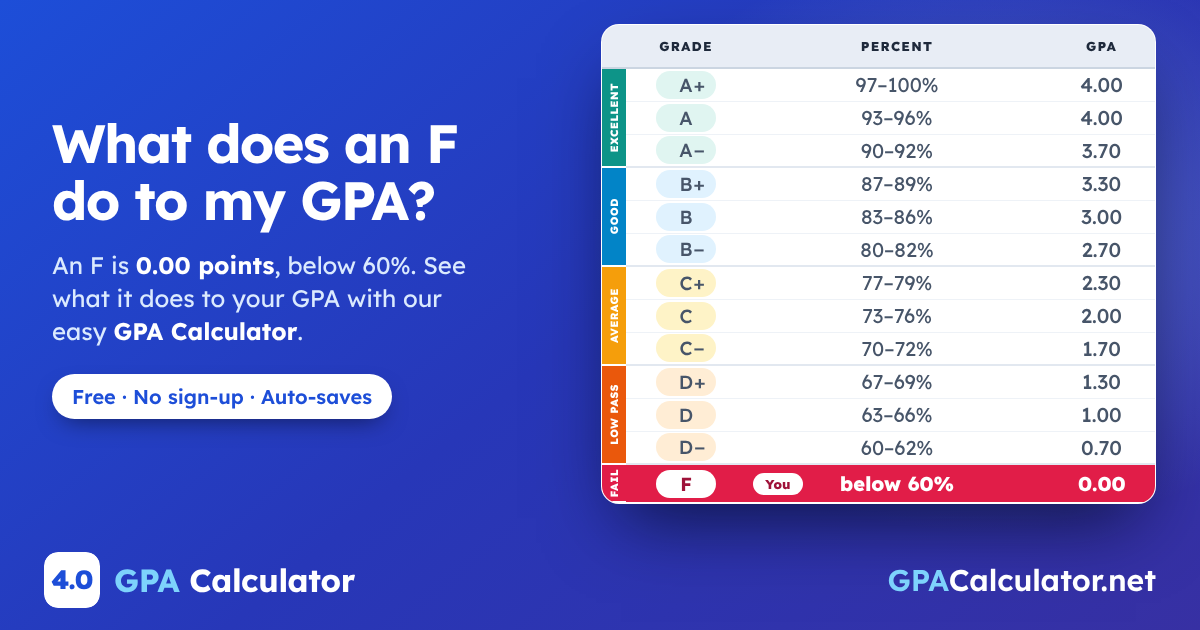
| Band | Letter grade | % range | Grade points |
|---|---|---|---|
| Excellent | A+ | 97–100% | 4.0 |
| A | 93–96% | 4.0 | |
| A− | 90–92% | 3.7 | |
| Good | B+ | 87–89% | 3.3 |
| B | 83–86% | 3.0 | |
| B− | 80–82% | 2.7 | |
| Average | C+ | 77–79% | 2.3 |
| C | 73–76% | 2.0 | |
| C− | 70–72% | 1.7 | |
| Low pass | D+ | 67–69% | 1.3 |
| D | 63–66% | 1.0 | |
| D− | 60–62% | 0.7 | |
| Fail | F | Below 60% | 0.0 |
What an F means
An F normally means the course was failed. On a conventional letter-grade GPA scale it contributes zero quality points, while the course’s GPA credits remain in the denominator. That is why an F lowers the average rather than simply being ignored.
Failing now? Check what the remaining work can change
A current F is not necessarily your final course grade. At 55% with a final worth 30%, you can reach 60% by scoring about 71.7% on the final. Reaching 70% would require 105%, so that goal is out of reach through this final alone if it is capped at 100%.
Use your exact current percentage, the final exam’s weight and the course percentage you want. Choose Exact % when your syllabus uses different cutoffs. This calculation assumes the final is the only work remaining.
Only the final exam left?
Use your current course percentage, the final exam’s weight and your target to find the exam score you need. This is for a course still in progress.
| Goal | Example course cutoff | Final score needed |
|---|---|---|
| Reach D− | 60% | 71.7% |
| Reach C− | 70% | 105% — above a 100% maximum |
| Reach C | 73% | 115% — above a 100% maximum |
How the calculation works
Required final score = [target − (55 × 0.70)] ÷ 0.30. For a 70% target, that is 105%.
Mid-semester: assignments still left?
Use the Grade Calculator to work out your course average and try possible scores for remaining homework, quizzes, exams or projects. Enter the weights from your syllabus.
What percentage is an F?
On this page’s example scale, F is below 60%. Your course may set a different passing cutoff, so use the syllabus rather than treating 60% as universal.
Percentage cutoffs decide the course letter; GPA points decide how that letter enters your GPA. These are separate rules. The school’s registrar publishes the GPA scale, while your syllabus explains course weights, cutoffs and rounding.
Do not count on an automatic round-up
If your course rounds to the nearest whole percent, 59.5% can round to 60%. If it keeps decimals or does not round, it does not. A calculator cannot grant a grade change that your course policy does not allow.
Already received an F? Compare your repeat options
If the F is already posted, the final-exam calculator cannot change it. Check whether you need the course for your program, when you can repeat it and how the school counts both attempts. A repeat may replace the old grade in your GPA or leave both attempts in the average.
For example, Boise State uses the most recent grade for eligible repeated courses under its current replacement policy, while both grades remain on the transcript. Do not assume a repeat removes the old record, or that another school or application service calculates GPA the same way.
| What you need to know | Where to check |
|---|---|
| Does the course earn credit? | School catalog and transcript legend |
| Does it satisfy this prerequisite or major course? | Specific course listing and program requirements |
| Will another school accept it? | Receiving school’s transfer evaluation |
| Must I repeat it? | Degree audit, adviser and repeat policy |
How many GPA points is an F?
| Published scale | F value |
|---|---|
| University of Iowa | F = 0.00 |
| Georgia Tech | F = 0.00 |
An F worth 0.00 is different from a grade excluded from GPA. An excluded course adds neither quality points nor GPA credits; an F ordinarily adds GPA credits without quality points.
For weighted high-school courses, check which classes qualify for a bonus and which grades receive it. Do not automatically add honors or AP points to the college values above.
What will one F do to your GPA?
Suppose your current GPA is 2.80 over 30 GPA credits, and you add a 3-credit F worth 0.00. Your new GPA is 2.55. This assumes the course is not already in your starting GPA.
The calculation
(2.80 × 30 + 0.00 × 3) ÷ 33 = 2.5455, or 2.55 rounded to two decimals.
Use credits included in your GPA, which may differ from total earned credits. The button below opens the GPA Calculator for your own course grades.
Already received your final course grade?
Use the GPA Calculator to combine this grade with your other course grades and credits. It calculates your semester or cumulative GPA—not the percentage within this one class. If your starting GPA already includes this course, do not add it again.
If you plan to retake a course already on your transcript, use the Course Repeat GPA Calculator with your school’s policy. For a longer-term goal, use the Raise GPA Calculator.
How replacing an F differs from counting both attempts
Start with 30 GPA credits at 2.80, before the failed 3-credit course. Adding the F gives 84 ÷ 33 = 2.55. Now suppose you repeat the same 3-credit course and earn B, worth 3.00.
| Repeat treatment | Calculation | New GPA |
|---|---|---|
| F excluded; new B counted | (84 + 9) ÷ 33 | 2.82 |
| Both F and B counted | (84 + 0 + 9) ÷ 36 | 2.58 |
If the course is still in progress and you are considering withdrawal or pass/no pass, check the available options and deadlines before acting. Read the W grade guide and P/NP guide; neither option is an automatic way to remove an existing F.
Frequently asked questions
What percentage is an F?
Below 60% on this example chart. The actual failing cutoff depends on your syllabus.
Does retaking an F erase it?
Not automatically. A school may replace its GPA effect while keeping both grades on your transcript, or may count both attempts. Check the repeat policy before estimating your new GPA.
What do I need on my final to improve an F?
It depends on your current percentage, final weight and target. With 55% before a final worth 30%, reaching 70% requires about 105% on the final. The example assumes no other work remains.
Can I calculate this from just my letter grade?
Only as an estimate. A letter covers a range of percentages. Enter your exact gradebook percentage for a useful final-exam target, and check how ungraded work is treated.
Does rounding my GPA change my course grade?
No. GPA rounding and course-percentage rounding are separate policies. A displayed GPA does not change the letter your instructor awards.