Fill in each row. Your result updates as you go.
How your result is calculated
Keep going
Fill in each row. Your result updates as you go.
How your result is calculated
Keep going
Wrong result or missing a feature? Send feedback
On this page · 6 sections
Indian percentages to US GPA
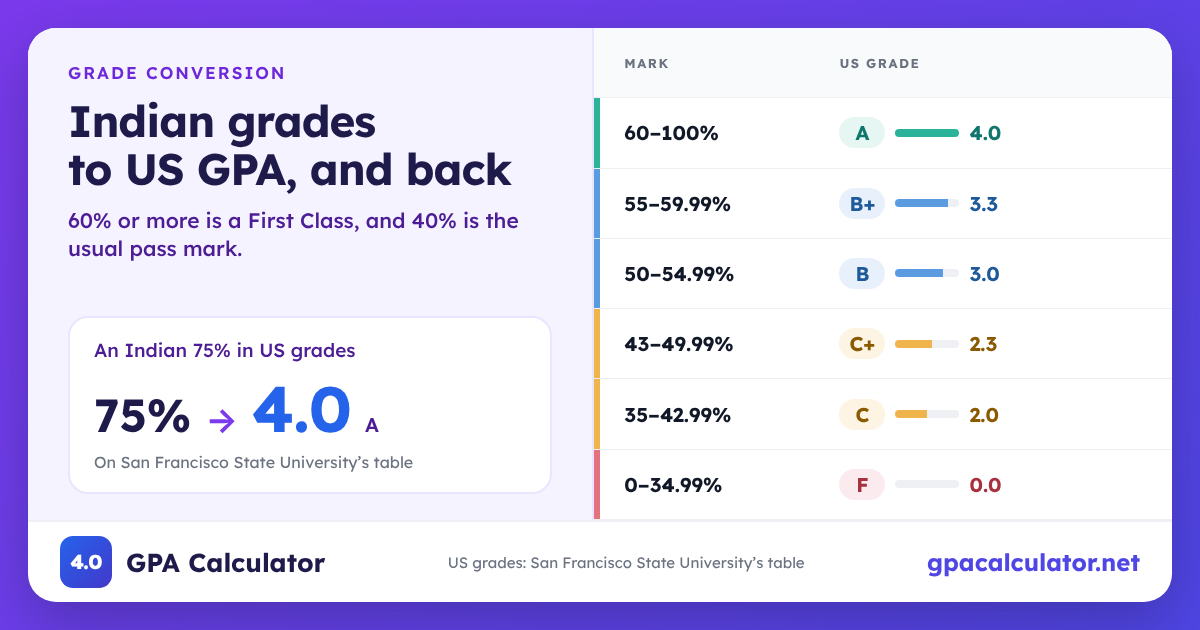
US universities convert Indian marks by class. San Francisco State University’s graduate admissions table splits the classes into US letters:
| Percentage | Class | US grade | Scholaro |
|---|---|---|---|
| 70–100%First Class with Distinction | First Class with Distinction | A · 4.0 | A+ · 4.0 |
| 60–69.99%First Class | First Class | A · 4.0 | A · 4.0 |
| 55–59.99%Second Class | Second Class | B+ · 3.3 | B · 3.0 |
| 50–54.99%Second Class | Second Class | B · 3.0 | B · 3.0 |
| 43–49.99%Third Class | Third Class | C+ · 2.3 | C · 2.0 |
| 40–42.99%Third Class | Third Class | C · 2.0 | C · 2.0 |
| 35–39.99%below 40% | below 40% | C · 2.0 | F · 0.0 |
| 0–34.99%below 35% | below 35% | F · 0.0 | F · 0.0 |
Both tables make 60% or more an A. ECE, a US credential evaluator, does the same: a First Class (60–69%) and a First with Distinction are both an A, a Second Class a B and a Third Class a C.
Exception
An A for each course is not the same as an admissions GPA. Oregon State University says a 60% First Class average is “generally equivalent to a B average”, a 3.0. Read which way your university converts before you apply.
CGPA (10-point) to US GPA
Under the UGC’s Choice Based Credit System, universities give each course a letter and grade points out of 10:
| Letter | Grade points | Meaning | US grade |
|---|---|---|---|
| OOutstanding | 10 | Outstanding | A+ · 4.0 |
| A+Excellent | 9 | Excellent | A · 4.0 |
| AVery Good | 8 | Very Good | AB · 3.5 |
| B+Good | 7 | Good | B · 3.0 |
| BAbove Average | 6 | Above Average | BC · 2.5 |
| CAverage | 5 | Average | C · 2.0 |
| PPass | 4 | Pass | C · 2.0 |
| FFail | 0 | Fail | F · 0.0 |
Enter a CGPA or SGPA under Indian scale to convert it. Oregon State treats a CGPA of 8 out of 10 as a B average (3.0), so here too admissions offices can be stricter than the course-by-course tables.
Note
Each university sets its own marks bands for the letters and its own CGPA-to-percentage rule: MANUU multiplies the CGPA by 10, and CBSE’s old Class 10 certificates multiplied it by 9.5. Use the rule printed on your marksheet.
US GPA in Indian terms
No Indian authority publishes a conversion from a US GPA. The US GPA → Indian converter uses the one published equivalence we found, from Oregon State University: a 3.0 GPA (B average) matches a First Class, 60% or more, or a CGPA of 8 out of 10.
Example
Say you have a 3.2 GPA from a US college. It is above 3.0, so on Oregon State’s equivalence it matches a First Class. Oregon State gives no level above or below that line.
How grades work in India
Older universities report percentages and a class (division); most now also report a CGPA. Under the CBCS, one creditUnder the UGC’s CBCS guidelines, one credit is one hour of teaching, or two hours of practical work, a week. is one hour of teaching a week, and the CGPA is the credit-weighted average of your grade points.
Tip
Enter credits as your marksheet shows them. A 4-credit theory course counts twice as much as a 2-credit lab, and only that ratio matters.
Worked example: one semester
Say a semester ended with 78%, 65%, 58% and 82% (this is Show an example):
| Course | Marks | Credits | US grade | Points × credits |
|---|---|---|---|---|
| Engineering Mathematics | 78% | 4 | A · 4.0 | 16.0 |
| Data Structures | 65% | 4 | A · 4.0 | 16.0 |
| Digital Electronics | 58% | 3 | B+ · 3.3 | 9.9 |
| Physics Lab | 82% | 2 | A · 4.0 | 8.0 |
| Total | 13 | 49.9 |
US GPA = 49.9 ÷ 13 = 3.84, from an average of 70%.
Myth vs fact
Myth
A CGPA converts to a US GPA by dividing by 10 and multiplying by 4.
Fact
That makes an 8.0 CGPA a 3.2. Scholaro’s table makes it 3.5 and Oregon State reads it as 3.0: grade scales aren’t proportional, so use a published table.
Class 12 marks
CBSE no longer declares an overall percentage, division or distinction for Class 10 and 12; the college you apply to picks the subjects it counts, often your best five. US colleges read the marksheet as it is.
Frequently asked questions
How do I convert my Indian percentage to a US GPA?
Convert each course with a published table, then average by credits. On SF State’s table 60% or more is an A (4.0), 55–59% a B+ and 50–54% a B. Some US universities instead treat a 60% average as a 3.0.
What is 60% in US GPA?
60% is a First Class. Course by course it is an A on SF State’s, Scholaro’s and ECE’s tables; as an overall average, Oregon State reads it as a B average, 3.0.
What is an 8 CGPA in US GPA?
On Scholaro’s UGC table an 8 is an A grade, AB or 3.5 in US terms. Oregon State treats an 8 out of 10 as a B average, 3.0.
How is GPA calculated in India?
Under the UGC’s CBCS each course gets grade points out of 10 (O = 10 to F = 0). The SGPA is the credit-weighted average for a semester and the CGPA for the whole programme.
Is there an official US GPA to Indian percentage conversion?
No. No Indian authority publishes one; universities and evaluators each use their own tables. The closest published line is Oregon State’s: a 3.0 GPA matches a First Class.
Updates
- October 10, 2026 New two-way converter: Indian percentages and 10-point CGPA to US GPA, and a US GPA in Indian terms.
Disclaimer. Results are estimates for planning. The university or credential evaluator you apply to decides your official converted grade, and its rules win when they differ from ours.
Sources
- Admission requirements: India San Francisco State University Graduate Admissions
- India Oregon State University Graduate Admissions
- Changes in Indian University Grading (TAICEP 2016) Educational Credential Evaluators
- Grading System in India Scholaro
- CBCS Regulations (UGC grade scale) Maulana Azad National Urdu University
- UGC Guidelines on Adoption of Choice Based Credit System University Grants Commission
- Circular No. 24 (2010) Central Board of Secondary Education
- CBSE board exam 2024: no overall division or aggregate marks AACRAO EDGE