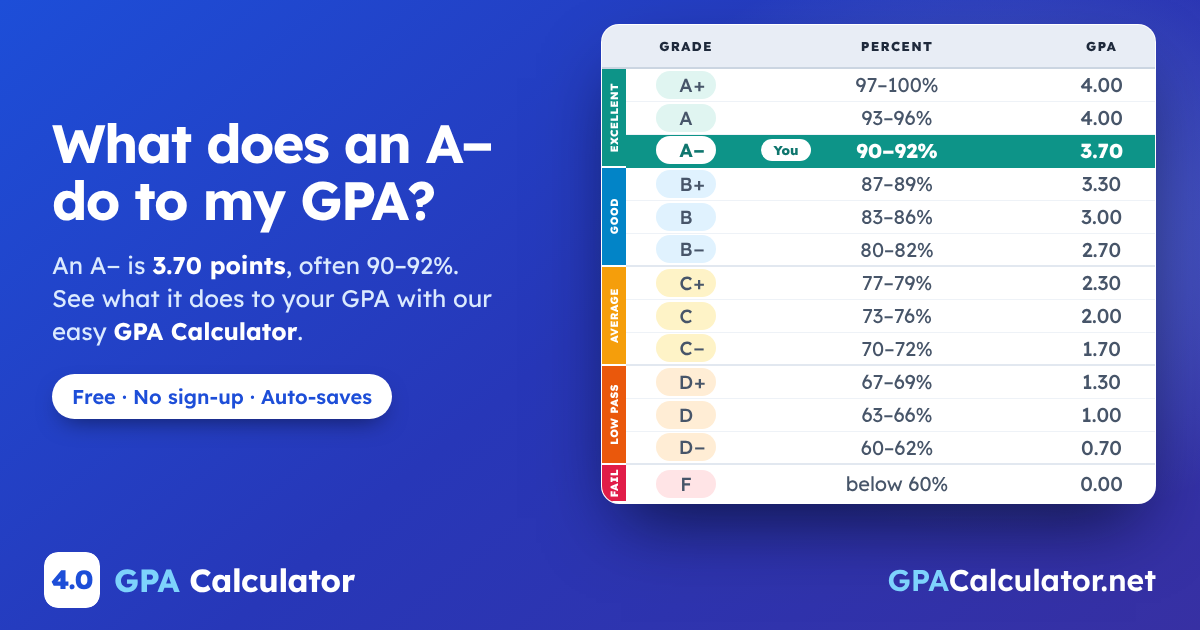
Pick any one. The other two follow.
On this page · 6 sections
| Band | Letter grade | % range | Grade points |
|---|---|---|---|
| Excellent | A+ | 97–100% | 4.0 |
| A | 93–96% | 4.0 | |
| A− | 90–92% | 3.7 | |
| Good | B+ | 87–89% | 3.3 |
| B | 83–86% | 3.0 | |
| B− | 80–82% | 2.7 | |
| Average | C+ | 77–79% | 2.3 |
| C | 73–76% | 2.0 | |
| C− | 70–72% | 1.7 | |
| Low pass | D+ | 67–69% | 1.3 |
| D | 63–66% | 1.0 | |
| D− | 60–62% | 0.7 | |
| Fail | F | Below 60% | 0.0 |
Can you turn your A− into an A?
Only the final exam left?
Use your current course percentage, the final exam’s weight and your target to find the exam score you need. This is for a course still in progress.
Use your exact current percentage, not just the A− label. Enter the final’s weight and choose A (93%), or Exact % if your syllabus uses another cutoff. You can also choose A− to see the score needed to keep it.
Check your current average
Enter the percentage before the final. Leave the ungraded final out of that average.
Find the final’s weight
Use the percentage in your syllabus. For an exam worth 20% of the course, enter 20.
Compare A− and A
Try 90% to protect A− and 93% to reach A, then adjust both to match your syllabus.
Mid-semester: assignments still left?
Calculate your current average or try possible homework, quiz and project scores before planning your final.
From 91% to an A: what your final must do
You have 91% before a final worth 30%. If A starts at 93%, the required exam score is about 97.7%.
| Goal | Course cutoff | Final score needed |
|---|---|---|
| Keep A− | 90% | 87.7% |
| Reach A | 93% | 97.7% |
| Reach A+, if awarded | 97% | 111% — above a 100% maximum |
How the calculation works
Your completed work contributes 63.7 points: 91 × 0.70. To reach 93, the final must add 29.3 points. 29.3 ÷ 0.30 = 97.666…%, shown as 97.7% so the displayed target reaches the goal.
The linked Final Grade Calculator lets you change the current grade, exam weight and goal. A result above 100% is out of reach on an exam capped at 100%, unless a published policy changes the calculation.
What percentage is an A−?
On the example scale here, A− runs from 90% to less than 93%. A 92.9% remains A− before rounding. These are example cutoffs; your course may use different ones.
Check the rounding rule
A 92.5% becomes 93% only under an applicable nearest-whole-number rounding policy. Also, a school without plus/minus grades does not automatically convert every A−-range percentage to A. Its own course cutoffs decide the letter.
See the full grade chart for neighboring grades.
How many GPA points is an A−?
The point value comes from your school’s official grading scale, usually published by the registrar. Keep 3.70 and 3.67 distinct when calculating a transcript GPA.
| School | Grade-point value |
|---|---|
| Stanford — general scale | 3.70 |
| UC Berkeley | 3.70 |
| University of Iowa | 3.67 |
What does one A− do to a 4.0 GPA?
An A− changes a perfect 4.00 on a scale where A− is below 4.00. Here is the actual size of the change: you have 15 GPA credits at 4.00 and add a 4-credit A−.
| A− value | New grade-point total | New cumulative GPA |
|---|---|---|
| 3.70 | 60 + 14.80 = 74.80 | 74.80 ÷ 19 = 3.94 |
| 3.67 | 60 + 14.68 = 74.68 | 74.68 ÷ 19 = 3.93 |
Use credits already included in your GPA, and add only new courses. Keep credit units consistent; do not mix semester and quarter credits without converting them.
Already received your final course grade?
Use the GPA Calculator to combine this grade with your other course grades and credits. It calculates your semester or cumulative GPA—not the percentage within this one class. If your starting GPA already includes this course, do not add it again.
Can more A’s bring your GPA back up?
Yes. In the 3.70-point example above, another 30 credits of A would bring your GPA to 3.98: (74.80 + 120) ÷ 49.
An exact 4.00 and a displayed 4.00 are different
If all future grades are capped at 4.00 and the A− remains included, more A’s bring the mathematical average closer to 4.00 without reaching it exactly. A rounded display may eventually show 4.00. Schools that award A+ above 4.00 follow different arithmetic.
Check the exact requirement if you are tracking an honors or scholarship threshold. Do not assume a rounded GPA meets a cutoff.
Plan your next semester
See the average you need over your remaining credits.
One A− is different from a 3.7 cumulative GPA, which averages all included courses.
A− grade questions
Is an A− a 3.7 or a 3.67?
Both are used. Stanford’s general scale and UC Berkeley use 3.70; the University of Iowa uses 3.67. Your school’s scale determines the correct value.
Is an A− a bad grade?
An A− is in the A range. Whether it meets a particular goal depends on the course and program. Calculate the actual GPA change instead of assuming one grade determines your academic record.
Can I get an A from 91% with a 20% final?
If A starts at 93%, you would need 101% on the final. With a maximum score of 100%, you would finish at 92.8% before any rounding.
Does an A− always lower my GPA?
No. An A− worth 3.70 raises a GPA below 3.70, leaves 3.70 unchanged and lowers a GPA above 3.70. Use 3.67 instead if that is your school’s value.
Can I round 3.67 up to 3.7?
Use the official point value in the calculation and apply the school’s GPA rounding rule at the end. Rounding each grade first can change the final GPA.