Past terms
One line per earlier term from your transcript. They add to the previous GPA above, so leave it empty if it already covers them.
Retakes
Many colleges drop the old grade once you retake a class, so it comes out of your previous GPA. Put the new grade in this term’s classes below. Some schools average both attempts: check your catalog.
Set your target GPA
How your GPA is calculated
Saved automatically on this device
GPA Planner
See the average you need in your upcoming credits to reach your goal.
Try a different average
Keep going
Wrong result or missing a feature? Send feedback
On this page · 8 sections
What cumulative GPA means and when to calculate it
Cumulative GPA is your grade point average across every graded class you’ve taken at your school, not just this term. To calculate it, add the quality points (grade points × credits) from all those classes and divide by your total graded credits.
This calculator joins the GPA and credits already on your transcript with the classes you’re taking now. If your transcript lists a GPA for each term instead of one overall number, add the terms one by one, and if you’re retaking a class, it takes the old grade out. Check it before grades post, when a scholarship, internship or major asks for a minimum, or when you’re worried a rough semester pulled you down. If you only want the GPA for one term, leave out the previous GPA and the result shows a Semester GPA instead.
How to find your cumulative GPA with the calculator
Add your previous GPA
Fill in Previous GPA and Credits completed above the rows, from your transcript or student portal. Only have term GPAs? Use + Add past terms; retaking a class? Use + Retaking a class?
Enter this term’s classes
Pick a Grade and Credits for each class; Course (optional) is just a label. Use + Add class for more rows and + Add semester for another term.
Check the combined number
Your result appears under Cumulative GPA as you type, with your previous GPA and this term side by side. Open How your GPA is calculated to see every class’s quality points.
How to calculate cumulative GPA, with an example
Cumulative GPA = (Previous GPA × Credits completed + New points) ÷ All GPA credits
Quality points
A class’s grade points times its credits, such as 3.7 × 3 = 11.1.
New points
The quality points from the classes you add in the calculator.
All GPA credits
Credits completed plus the credits of every new graded class.
Say your transcript shows a 3.20 over 45 credits, and this fall you take four classes. On the standard 4.0 scale an A is 4.0, an A− 3.7, a B+ 3.3 and a B 3.0; your school sets its own cutoffs. Here are the fall classes.
| Course | Grade | Grade points × credits | Quality points |
|---|---|---|---|
| ECON 201 | A− | 3.7 × 3 | 11.1 |
| STAT 210 | B+ | 3.3 × 4 | 13.2 |
| ENG 220 | A | 4.0 × 3 | 12.0 |
| BIO 105 | B | 3.0 × 1 | 3.0 |
| Fall total | 11 credits | 39.3 |
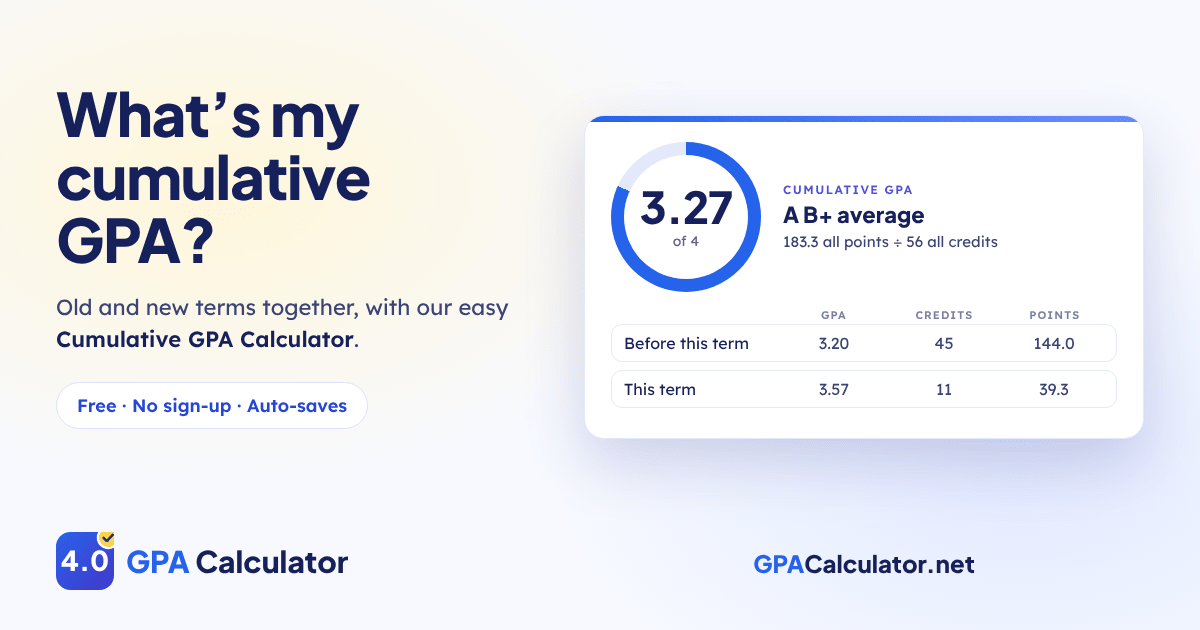
Your old GPA is worth 3.20 × 45 = 144 quality points. Add the fall points to get 183.3, then divide by 56 credits (45 + 11). That gives 3.273.
The calculator shows a Cumulative GPA of 3.27, with 56 GPA credits and 183.3 quality points. Your fall term alone works out to 3.57, but 45 earlier credits keep the overall number much closer to where it started.
How much can one semester change your cumulative GPA?
Less every year. The table starts from a 3.00 cumulative GPA and adds one 15-credit semester with a term GPA of 2.0, 2.5, 3.5 or 4.0. Find the credits you’ve already finished, then read across.
| Credits done | 2.0 term | 2.5 term | 3.5 term | 4.0 term |
|---|---|---|---|---|
| 15 | 2.50 | 2.75 | 3.25 | 3.50 |
| 30 | 2.67 | 2.83 | 3.17 | 3.33 |
| 60 | 2.80 | 2.90 | 3.10 | 3.20 |
| 90 | 2.86 | 2.93 | 3.07 | 3.14 |
A straight-A semester lifts a 3.00 to 3.50 after 15 credits, but only to 3.14 after 90. A rough term works the same way: a 2.0 semester costs half a point early on and about 0.14 by senior year. Use the calculator’s Step 2 to see how many terms of what grades it takes to reach your target, or the Raise GPA Calculator to plan class by class.
What is my cumulative GPA? Reading the result
The big number is your cumulative GPA to two decimals, and the line under it names the letter it matches, such as “a solid B average” for 3.27. Beside it, Previous, this term and Overall show how the two parts combine, and Where you stand places you against the 3.26 average of U.S. bachelor’s graduates and the 2.0 most colleges require. The credits and classes counted are listed under the bar.
Your calculation saves on this device automatically, so you can come back and add next term; Save or print your GPA keeps a copy or a link. If the number is lower than a requirement you’re aiming for, pick a target in Step 2: Set your target GPA to see the average you’d need over the credits you have left.
A result under 2.0 shows its ring in red. Your school’s catalog sets the exact GPA you need to stay in good standing, so check it there.
What changes a cumulative GPA in college
Credits, not semesters, carry the weight. You can’t average your term GPAs, because terms rarely have the same number of credits. A 4.0 over 15 fall credits and a 2.0 over 3 summer credits average to 3.0, but the real cumulative GPA is (60 + 6) ÷ 18 = 3.67.
The more credits you’ve finished, the slower it moves. One strong term can lift a freshman’s GPA a lot, while the same grades barely nudge a senior’s. That is why the example’s 3.57 term only raised a 3.20 to 3.27.
Transfer credits usually stay out. Some colleges count transfer classes toward your degree but not your GPA. Portland State and the University of Arizona both leave grades from other colleges out of the GPA on their transcripts, so don’t add those classes here.
Repeated courses follow your school’s rule. Some colleges replace the first grade with the new one, others count both attempts. The University of Arizona, for example, allows the same course at most three times and says the GPA effect of a repeat depends on your program. If your school replaces grades, open + Retaking a class? and enter the old grade and credits: the calculator takes them out of your previous GPA, and the new grade goes in with this term’s classes. A 2.80 over 60 credits with an F in a 3-credit class becomes 3.00 when the retake earns an A, instead of 2.86 if both attempts counted.
Pass/no pass and withdrawals. The calculator lists P, NP and W as not counted, so those rows add no credits or points. Both registrars above leave pass/fail classes out of the GPA. A different scale under Options, such as 4.0 scale, A+ = 4.33, changes what an A+ adds.
Is cumulative GPA weighted or unweighted?
In college it’s unweighted: every class counts on the same scale, an A is a 4.0 (4.33 for an A+ at some schools), and harder classes don’t earn extra points. Your transcript’s cumulative GPA is that number.
High schools often report both. The unweighted cumulative GPA treats every class on the 4.0 scale; the weighted one adds a bonus, often 0.5 for Honors and 1.0 for AP or IB, so it can go above 4.0. Use the Weighted GPA Calculator when your school adds those points.
Cumulative GPA in high school
A high school cumulative GPA covers every graded class from 9th grade on, weighted by credits the same way: a year-long class is usually 1 credit and a semester class 0.5. It’s the GPA on your transcript and the one colleges see first, though many recalculate it themselves from your core classes.
This calculator is set up for college credits and the 4.0 scale. For high school classes with Honors, AP or IB levels, use the High School GPA Calculator, which keeps weighted and unweighted GPAs side by side.
Frequently asked questions
How do I calculate my cumulative GPA?
Add up the quality points from every graded class and divide by the total graded credits. If you already know your GPA, multiply it by your credits completed to get your old points, add the new term’s points, and divide by all the credits. A 3.0 over 30 credits plus a 12-credit term worth 42 points gives 132 ÷ 42 = 3.14.
What is a cumulative GPA?
It is the credit-weighted average of every graded class you’ve taken at your school so far, not just one term. It’s usually the overall figure printed on your transcript.
Is CGPA the same as cumulative GPA?
Yes, CGPA is short for cumulative grade point average. The math is the same either way: total quality points divided by total graded credits.
How do I find my cumulative GPA?
Your transcript or student portal shows it once grades post for a term. To see it before then, enter your current cumulative GPA and credits completed in the line above the rows, add this term’s classes, and read the new number.
How do you calculate CGPA from GPA?
Weight each term’s GPA by its graded credits instead of averaging the term GPAs. Multiply every term GPA by that term’s credits, add the results, and divide by the total credits. A plain average is right only when every term had the same number of credits.
Is cumulative GPA weighted or unweighted?
In college it’s unweighted: every class counts on the same 4.0 scale. High schools may report both, with Honors, AP or IB bonuses in the weighted one, so check which number a scholarship or application asks for.
Does retaking a class replace the grade in my cumulative GPA?
Many colleges replace the old grade with the new one, at least for a limited number of credits, and others average both attempts. With replacement, the old grade’s points and credits leave your GPA. Use + Retaking a class? in the calculator to see the effect, and check your catalog’s repeat policy.
Do transfer credits count toward cumulative GPA?
Usually not. Most colleges count transfer classes toward your degree but leave their grades out of your GPA, so your cumulative GPA covers only classes taken at your current school. Some university systems count grades from their other campuses, so check with your registrar.
How much can one semester raise my cumulative GPA?
It depends on how many credits you’ve finished. From a 3.00, a 15-credit semester of straight A’s reaches 3.50 after 15 credits but only 3.14 after 90 credits. The table on this page shows more combinations.
What is a good cumulative GPA?
A 3.0 is a common cutoff for scholarships, internships and many majors, and 2.0 is the usual minimum to stay in good standing. U.S. bachelor’s graduates averaged 3.26 in 2016, according to the National Center for Education Statistics.
Sources
- Calculating Grade Point AveragePortland State University Office of the Registrar
- Grades and Grade Point Average (GPA) CalculationUniversity of Arizona Office of the Registrar