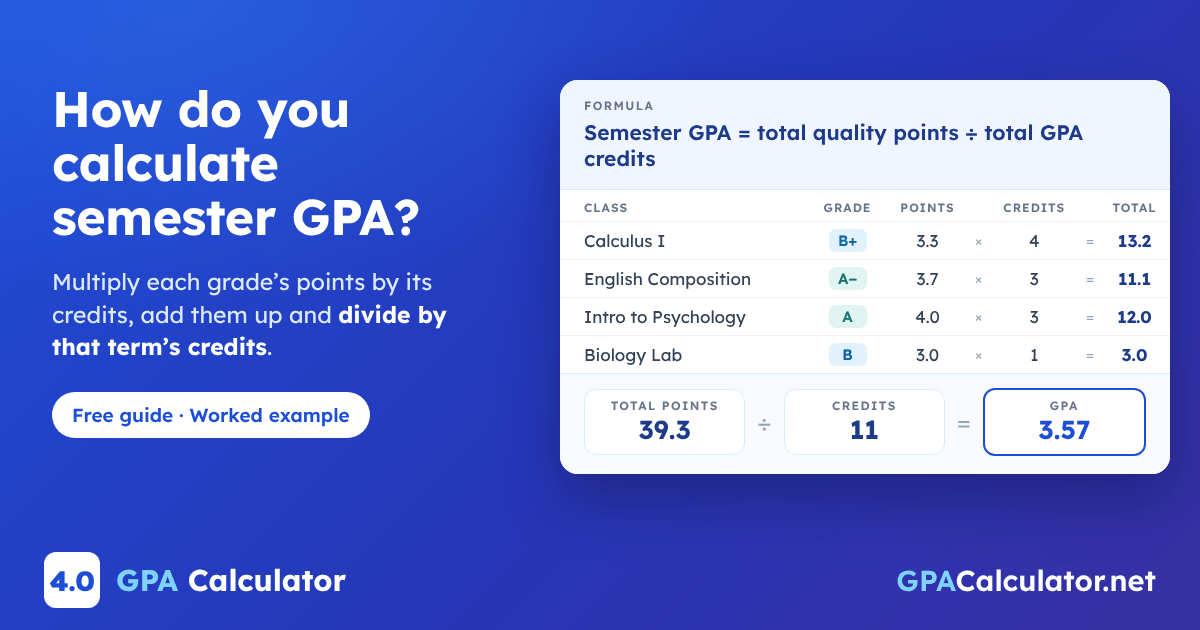
To calculate your semester GPA, multiply each course’s grade points by its credits. Add those results together, then divide by the total credits included in your GPA for that semester.
Semester GPA = Total quality points ÷ Total GPA credits
Quality points
Grade points × course credits, for each class.
GPA credits
Credits from your letter-graded classes, including any F.
On this page · 6 sections
What is semester GPA?
- It’s your grade point average (GPA) for one term only.
- Cumulative GPA combines every graded term, so one semester moves it less as your record grows.
- Higher-credit classes carry more weight: a 4-credit grade counts four times as much as a 1-credit one.
- Semester GPA combines every letter-graded class you took that term. A semester grade calculator works out the final grade inside one class.
How to calculate your semester GPA
Three steps take you from report card to semester GPA.
Step 1: Convert letter grades into grade points
Look up each letter on the 4.0 scale below. Your school sets its own percent cutoffs.
| Band | Letter grade | % range | Grade points |
|---|---|---|---|
| Excellent | A+ | 97–100 | 4.0 |
| A | 93–96 | 4.0 | |
| A− | 90–92 | 3.7 | |
| Good | B+ | 87–89 | 3.3 |
| B | 83–86 | 3.0 | |
| B− | 80–82 | 2.7 | |
| Average | C+ | 77–79 | 2.3 |
| C | 73–76 | 2.0 | |
| C− | 70–72 | 1.7 | |
| Low pass | D+ | 67–69 | 1.3 |
| D | 63–66 | 1.0 | |
| D− | 60–62 | 0.7 | |
| Fail | F | Below 60 | 0.0 |
Point values vary: Cornell counts an A+ as 4.3, the University of Arizona uses whole letters only (A = 4 down to E = 0), and the University of Memphis gives an A− 3.84. Use your school’s values, and compare more scales in our GPA scale guide.
Step 2: Multiply grade points by course credits
A B+ (3.3) in a 4-credit class earns 3.3 × 4 = 13.2 quality points. Do this for every letter-graded class.
Step 3: Add quality points and divide by total GPA credits
Use GPA credits, not every credit you enrolled in. Section 4 shows which classes count.
Heads-up Don’t average the grade points alone. An A (4.0) in a 1-credit lab and a C (2.0) in a 4-credit class average to 3.0, but the real GPA is (4 + 8) ÷ 5 = 2.40.
Semester GPA calculation example
Here is a four-class, 12-credit semester, from letter grades to GPA.
| Course | Grade | Grade points | Credits | Quality points | |||
|---|---|---|---|---|---|---|---|
| English Composition | A | 4.0 | 3 | 12.0 | |||
| Calculus I | B+ | 3.3 | 4 | 13.2 | |||
| Intro to Psychology | A– | 3.7 | 3 | 11.1 | |||
| General Biology | C+ | 2.3 | 2 | 4.6 | |||
Total quality points 40.9 Credits counted 12 GPA 3.41 | |||||||
Semester GPA = 40.9 ÷ 12 = 3.4083… ≈ 3.41
That’s rounded to two decimal places. If your school truncates instead (drops the extra digits without rounding), the same semester shows as 3.40 on your transcript.
Which grades and credits count?
Only letter grades go into the math. Here is how other grades are handled, with real school policies under the table.
| Grade or class | Quality points | In GPA credits? |
|---|---|---|
| Letter grade (A to D−) | Points × credits | Yes |
| F | 0.0 | Yes, so it lowers your GPA |
| Pass (P, S, CR) | None | No |
| Fail in a pass/fail class | Varies by school | Varies by school |
| Withdrawal (W) | None | No |
| Incomplete (I) | None for now | Not until a grade is posted |
| Repeated course | Varies by school | Replaced or averaged |
At the University of Memphis, W, I, CR and NC grades stay out of GPA, an F earns zero points, and a retake replaces the first attempt in your cumulative GPA. Without a replacement rule, both attempts stay in. The University of Arizona leaves pass/fail classes out whether you pass or fail, and counts an incomplete only once it becomes a letter grade.
Enrolled, earned and GPA credits
Your record can show three different credit totals, and only one of them goes into the formula.
| Credit total | What it counts | Example |
|---|---|---|
| Enrolled credits | Every class you registered for | 16 |
| Earned credits | Classes you passed, including Pass grades | 13 |
| GPA credits | Letter-graded classes, including any F | 12 |
The example is the semester above plus a passed 1-credit pass/fail seminar and a 3-credit class dropped with a W. Your GPA still divides by 12, so it stays 3.41.
Semester GPA vs. cumulative GPA
Your cumulative GPA adds this semester’s quality points and credits to everything before it. Say you started the term with 30 GPA credits and 90 quality points, a 3.00.
| Record | GPA credits | Quality points | GPA |
|---|---|---|---|
| Before this semester | 30 | 90 | 3.00 |
| This semester | 12 | 40.9 | 3.41 |
| Updated cumulative | 42 | 130.9 | 3.12 |
Updated cumulative GPA = (90 + 40.9) ÷ (30 + 12) = 130.9 ÷ 42 ≈ 3.12
Averaging the two GPAs, (3.00 + 3.41) ÷ 2 = 3.205, is too high, because your earlier 30 credits outweigh this semester’s 12. Our cumulative GPA guide covers tracking every term.
Can you calculate high school semester GPA the same way?
Yes, with two checks. First, if every class carries the same credit, your semester GPA is simply the average of your grade points. Four classes at 0.5 credit each with an A, B+, B and A− give (4.0 + 3.3 + 3.0 + 3.7) ÷ 4 = 3.50.
Second, check whether your school weights grades. Some high schools add a boost for Honors, AP or IB classes, so an AP A might count as 5.0 instead of 4.0. Your handbook lists the boosts.
The High School GPA Calculator shows both, with AP, Honors and IB boosts built in.
Frequently asked questions
Can I calculate semester GPA if all my classes have equal credits?
Yes. When every class has the same credit, add up the grade points and divide by the number of classes. An A, B and C in three 3-credit classes give (4.0 + 3.0 + 2.0) ÷ 3 = 3.00.
Does an F count toward semester GPA?
Yes. An F earns 0.0 quality points, but its credits still count in the total you divide by. Adding a 3-credit F to the example semester drops it from 3.41 to 40.9 ÷ 15 = 2.73.
Do pass/fail classes affect semester GPA?
A pass doesn’t, because pass/fail classes carry no grade points and stay out of your GPA credits. They still add to your earned credits. Schools like the University of Arizona leave a failed pass/fail class out too, but check your own catalog.
Why is my calculated GPA different from my transcript?
Your school may use different grade points, such as 4.3 for an A+ or 3.84 for an A−, or it may truncate instead of rounding. Retakes, incompletes and transfer credits can also change which classes count. Your registrar’s GPA rules explain the exact method.
Can one strong semester raise my cumulative GPA?
Yes, but how much depends on the credits you already have. A 3.41 semester lifts a 30-credit 3.00 record to 3.12, while the same semester after 90 credits only reaches 3.05. Early semesters move your cumulative GPA the most.
Sources
- Explanation of Grading on the TranscriptCornell University Office of the University Registrar · cornell.edu
- Grades and Grade Point Average (GPA) CalculationUniversity of Arizona Office of the Registrar · arizona.edu
- Grading Scale and GPAUniversity of Memphis Registrar · memphis.edu