Pick any one. The other two follow.What a GPA means
What if it’s weighted?
A 1.8 weighted GPA is about a 1.55 unweighted, a C− (69–70%).
- Est. unweighted GPA
- 1.55
- Letter grade
- C−
- Percentage
- 69–70%
Starts at a typical load, 24 classes with 6 AP/IB. Enter your own and the estimate updates.
Uses +1.0 for AP/IB and +0.5 for Honors, the most common boosts; your school may differ. Our calculate your GPA works from your own classes and grades, and the Weighted GPA calculator shows both numbers.
Look up any letter grade on the GPA scale, or use Grade Conversion.
On this page · 3 sections
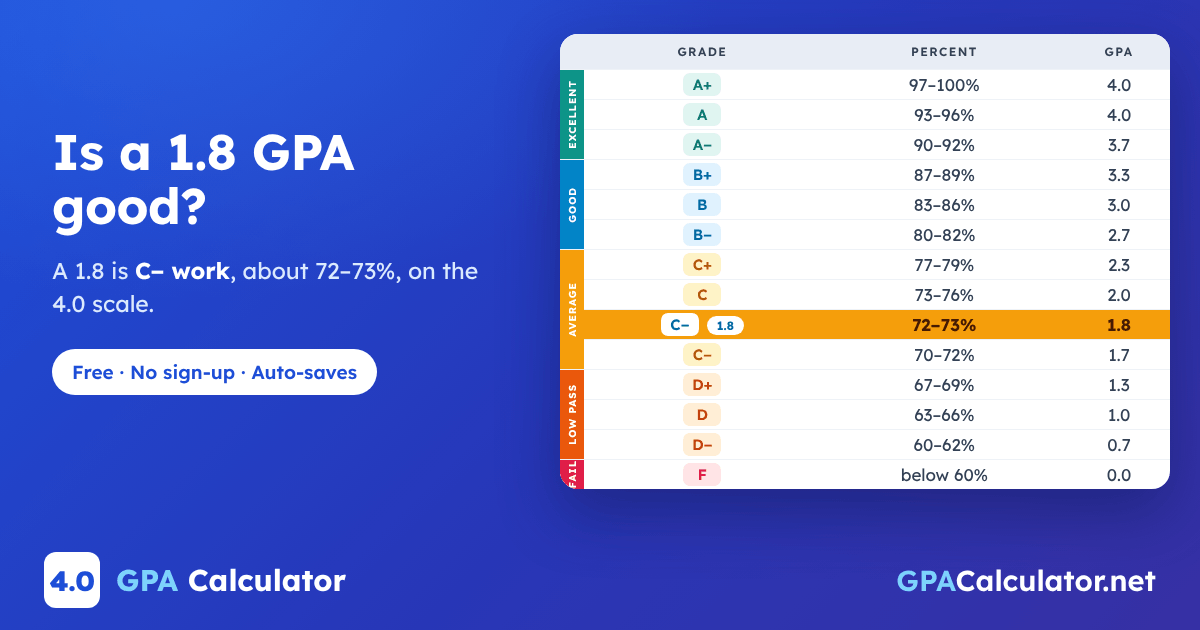
Here is where a 1.8 sits on the standard 4.0 scale, from A+ down to F:
| Band | Letter grade | % range | Grade points |
|---|---|---|---|
| Excellent | A+ | 97–100% | 4.0 |
| A | 93–96% | 4.0 | |
| A− | 90–92% | 3.7 | |
| Good | B+ | 87–89% | 3.3 |
| B | 83–86% | 3.0 | |
| B− | 80–82% | 2.7 | |
| Average | C+ | 77–79% | 2.3 |
| C | 73–76% | 2.0 | |
| C− | 72–73% | 1.8 | |
| C− | 70–72% | 1.7 | |
| Low pass | D+ | 67–69% | 1.3 |
| D | 63–66% | 1.0 | |
| D− | 60–62% | 0.7 | |
| Fail | F | Below 60% | 0.0 |
Is a 1.8 GPA good?
No. A 1.8 is well below average: C− work, 72–73%, against a national average of 3.11 for 2019 graduates (NAEP High School Transcript Study). It is under the 2.0 that many colleges set as a minimum, so raising it is the priority. Since your grade point average is cumulative, each new grade pulls a 1.8 up or down by less over time.
In high school
Most four-year colleges will not admit a student below 2.0. Use the time you have left in high school to raise it; community colleges are open-admission and a common route to a four-year degree.
In college
In college a GPA below 2.0 usually means academic probation, which can affect financial aid. Talk to an academic advisor about a plan.
How a 1.8 compares to real cutoffs
- Short: Cal Grant B: 2.0, 0.2 short
- Short: NCAA Division II: 2.2, 0.4 short
- Short: NCAA Division I: 2.3, 0.5 short
Cutoffs vary, so check your own school or program.
Where a 1.8 GPA stands
A 1.8 is at or above 0 of these 6 national GPA marks. For colleges, the mark is the typical average GPA of their new students, on a 4.0 scale.
- High school average3.11, above your GPA
- Middle college graduate3.30, above your GPA
- Colleges that admit 75%+3.46, above your GPA
- Colleges that admit 50–74%3.58, above your GPA
- Top 10% of college graduates3.85, above your GPA
- Colleges that admit under 10%3.92, above your GPA
- New college students in this range
- 2%
- had a high school GPA below 2.0, among students who took the SAT or ACT.
- College graduates with a lower GPA
- Under 10%
- Estimated from bachelor's graduates in the latest federal data.
Data: NAEP High School Transcript Study; NCES Beginning Postsecondary Students 2020/22 and Baccalaureate and Beyond 2016/20; colleges' Common Data Sets (243 colleges).
What a 1.8 GPA means for college
With a 1.8 most four-year colleges will not admit you directly. Community colleges are open-admission, and many students transfer to a four-year college after earning good grades there.
If you are still in high school, every semester of better grades counts. Ask your counselor about credit recovery for classes you failed.
Freshman
Most of high school is still ahead of you, so a 1.8 now can change a lot. Every semester of better grades pulls your average up; the table below shows how many strong classes it takes to reach a 2.0.
Sophomore
You are about halfway through, and raising a 1.8 is still realistic. Focus first on the classes where you are closest to the next grade, and turn in every assignment. Colleges also notice an upward trend.
Junior
Junior-year grades are the last full year most colleges see before you apply, so they count. Even if your overall GPA moves only a little, strong junior grades show an upward trend. Ask your counselor about retaking classes you failed.
Senior
Your GPA will not move much before applications, so plan around it: apply to colleges whose requirements you meet, including community colleges, and keep your senior grades up, because colleges see them and some offers depend on them.
How to raise a 1.8 GPA
The more classes you have finished, the more it takes to move your GPA. This table shows how many more classes you would need at one grade to bring a 1.8 up to a 2.0, assuming every class counts the same.
| Classes so far | Classes of A’s needed | Classes of B+’s needed |
|---|---|---|
| 8 | 1 | 2 |
| 16 | 2 | 3 |
| 24 | 3 | 4 |
To use your own classes, credits and target, try the Raise GPA calculator.
What helps
Now that you know where you stand it’s a good idea to think about ways to raise your GPA.
- Identify Your Challenges: Chances are some classes are harder for you than others. Do you struggle in early morning classes? Or classes that require a lot of reading? Is math a struggle for you? Try to figure out what’s really dragging down your grades and then make a plan to fix the problem.
- Plan Your Schedule Well: It can be overwhelming to choose classes each semester, but if possible, don’t overload yourself with work. You’ll be much more likely to get a good GPA if you steer away from advanced classes and take a light course load.
- Join a Study Group: Sometimes a study group can be just the accountability you need to get your grades on track. Make a group with others in your class or reach out to a counselor or teacher to find out if any groups are already up and running.
1.8 GPA – Frequently asked questions
How does a 1.8 GPA rank against other students?
Most students finish well above it. The latest national transcript study put the 2019 graduating class at 3.11 on average, 1.31 more than a 1.8. Some schools admit in this range anyway; Regent University reports 6% of 2023–24 first-years between 1.00 and 1.99.
What letter grade and percentage is a 1.8 GPA?
Just past C−, in the 72–73% band. Do the equal-credit math on two B’s plus three D’s and you get 1.8.
Why is a 1.8 GPA slow to raise?
Because 90 credits are already in it. Moving a 1.8 to 2.0 at that point takes 9 credits of A’s, 3 three-credit classes, or 18 credits of B’s.
Is a 1.8 GPA enough to graduate from college?
Not at the University of Florida or Arizona State: both require a 2.0 cumulative GPA to graduate. A 1.8 at 60 credits is 12 quality points short; 6 credits of A’s cover it.
Does a 1.8 GPA affect federal financial aid?
It can, mostly once your second year ends. That’s the point where federal rules need a C average (or standing that keeps you on track to graduate). At 48 credits, a 1.8 needs 10 credits of B’s to get there.
Sources
- 34 CFR § 668.34: Satisfactory academic progressElectronic Code of Federal Regulations (eCFR) · ecfr.gov
- California Education Code § 69435.3: Cal Grant B entitlementCalifornia Legislative Information · ca.gov
- Division II Initial Eligibility RequirementsNCAA Eligibility Center · ncaa.org
- Division I Initial Eligibility RequirementsNCAA Eligibility Center · ncaa.org
- Average GPA of high school graduates rose to 3.11 in 2019 (High School Transcript Study)National Assessment Governing Board · nagb.gov
- Regent University Common Data Set 2023–24Regent University · regent.edu
- Academic Progress PoliciesUniversity of Florida Undergraduate Catalog · ufl.edu
- University Undergraduate Graduation RequirementsArizona State University Catalog · asu.edu