Pick any one. The other two follow.What a GPA means
What if it’s weighted?
A 2.1 weighted GPA is about a 1.85 unweighted, a C−/C (72–73%).
- Est. unweighted GPA
- 1.85
- Letter grade
- C−/C
- Percentage
- 72–73%
Starts at a typical load, 24 classes with 6 AP/IB. Enter your own and the estimate updates.
Uses +1.0 for AP/IB and +0.5 for Honors, the most common boosts; your school may differ. Our check your GPA works from your own classes and grades, and the Weighted GPA calculator shows both numbers.
Look up any letter grade on the GPA scale, or use Grade Conversion.
On this page · 3 sections
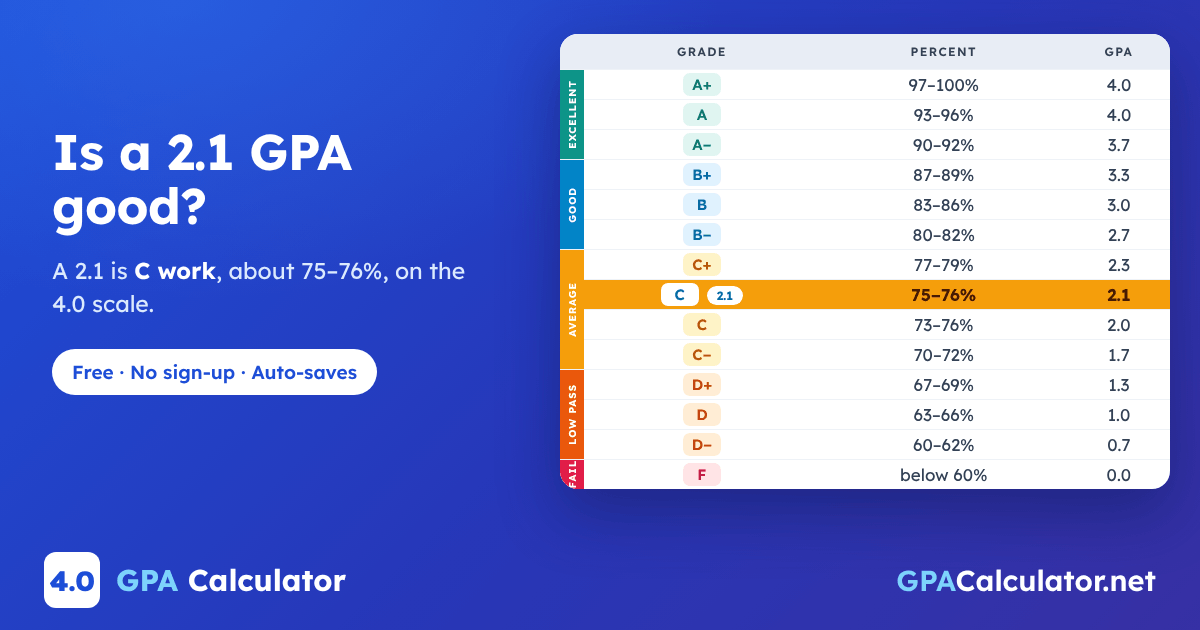
Here is where a 2.1 sits on the standard 4.0 scale, from A+ down to F:
| Band | Letter grade | % range | Grade points |
|---|---|---|---|
| Excellent | A+ | 97–100% | 4.0 |
| A | 93–96% | 4.0 | |
| A− | 90–92% | 3.7 | |
| Good | B+ | 87–89% | 3.3 |
| B | 83–86% | 3.0 | |
| B− | 80–82% | 2.7 | |
| Average | C+ | 77–79% | 2.3 |
| C | 75–76% | 2.1 | |
| C | 73–76% | 2.0 | |
| C− | 70–72% | 1.7 | |
| Low pass | D+ | 67–69% | 1.3 |
| D | 63–66% | 1.0 | |
| D− | 60–62% | 0.7 | |
| Fail | F | Below 60% | 0.0 |
Is a 2.1 GPA good?
A 2.1 is below average. It works out to C work, 75–76%, against a national average of 3.11 for 2019 graduates (NAEP High School Transcript Study). It meets the minimum at some colleges but leaves little room. Schools and the NCAA both read a grade point average, though they don’t always count the same courses.
In high school
Many four-year colleges look for at least a 2.5, so this GPA limits your choices. Community colleges and open-admission schools remain open to you while you work on it.
In college
In college you are in good standing (usually 2.0 or above), but some majors, scholarships and graduate programs require more.
How a 2.1 compares to real cutoffs
- Meets: Federal aid: 2.0, meets
- Short: NCAA Division II: 2.2, 0.1 short
- Short: NCAA Division I: 2.3, 0.2 short
Cutoffs vary, so check your own school or program.
Where a 2.1 GPA stands
A 2.1 is at or above 0 of these 6 national GPA marks. For colleges, the mark is the typical average GPA of their new students, on a 4.0 scale.
- High school average3.11, above your GPA
- Middle college graduate3.30, above your GPA
- Colleges that admit 75%+3.46, above your GPA
- Colleges that admit 50–74%3.58, above your GPA
- Top 10% of college graduates3.85, above your GPA
- Colleges that admit under 10%3.92, above your GPA
- New college students in this range
- 7%
- had a high school GPA of 2.0–2.4, among students who took the SAT or ACT.
- College graduates with a lower GPA
- Under 10%
- Estimated from bachelor's graduates in the latest federal data.
Data: NAEP High School Transcript Study; NCES Beginning Postsecondary Students 2020/22 and Baccalaureate and Beyond 2016/20; colleges' Common Data Sets (243 colleges).
What a 2.1 GPA means for college
A 2.1 meets the minimum at some four-year colleges and at all open-admission and community colleges. Many colleges look for 2.5 or higher, so your choices are limited for now.
Raising your GPA before you apply, or starting at a community college and transferring after a strong first year, opens more options.
Freshman
Most of high school is still ahead of you, so a 2.1 now can change a lot. Every semester of better grades pulls your average up; the table below shows how many strong classes it takes to reach a 2.5.
Sophomore
You are about halfway through, and raising a 2.1 is still realistic. Focus first on the classes where you are closest to the next grade, and turn in every assignment. Colleges also notice an upward trend.
Junior
Junior-year grades are the last full year most colleges see before you apply, so they count. Even if your overall GPA moves only a little, strong junior grades show an upward trend. Ask your counselor about retaking classes you failed.
Senior
Your GPA will not move much before applications, so plan around it: apply to colleges whose requirements you meet, including community colleges, and keep your senior grades up, because colleges see them and some offers depend on them.
How to raise a 2.1 GPA
The more classes you have finished, the more it takes to move your GPA. This table shows how many more classes you would need at one grade to bring a 2.1 up to a 2.5, assuming every class counts the same.
| Classes so far | Classes of A’s needed | Classes of B+’s needed |
|---|---|---|
| 8 | 3 | 4 |
| 16 | 5 | 8 |
| 24 | 7 | 12 |
To use your own classes, credits and target, try the Raise GPA calculator.
What helps
Now that you know what a 2.1 GPA is, you may want to consider what you can do to raise it.
- Study First: Set aside time to study while you’re at your best. If you work well in the mornings, study then. If you focus best after dinner make that your study time.
- Focus your Efforts: Everyone has some classes that are harder than others. Focus your extra study efforts on your lowest grades. Bringing those low grades up can raise your entire GPA!
- Seek Advice: Don’t be afraid to ask for help! Set an appointment with a school counselor, teacher or teacher’s aid and ask for help on things that you just can’t figure out on your own.
2.1 GPA – Frequently asked questions
What are your college chances with a 2.1 GPA?
It’s below average, a C just past the 2.0 line. Admission is still realistic: Plymouth State University placed 11% of its 2024–25 entering class at 2.00–2.49, and Keene State College 10.9%. For comparison, the most recent national average is 3.11, from 2019 graduates.
What letter grade and percentage is a 2.1 GPA?
Still a C (75–76%), just over the 2.0 line. Six C’s and a single B− across seven courses of the same credit average exactly 2.1.
How fast can a 2.1 GPA reach 2.5?
Forty-five credits at 2.1 is a lot of history to move. To reach 2.5 you’d need 12 credits of A’s (about 4 courses), or 23 credits of B+’s.
Can a 2.1 GPA play college sports?
Not yet, for Division I or II. Their core-course minimums are 2.3 and 2.2. Suppose 14 of 16 core classes average 2.1: the final two would need 2.9 for Division II, 3.7 for Division I.
Can you graduate with a 2.1 GPA?
Yes at schools like Florida and Arizona State, where 2.0 is the minimum to graduate. The margin is thin: at 90 credits, one 3-credit F would pull a 2.1 down to 2.03.
Sources
- Division I Initial Eligibility RequirementsNCAA Eligibility Center
- 34 CFR § 668.34: Satisfactory academic progressElectronic Code of Federal Regulations (eCFR)
- Division II Initial Eligibility RequirementsNCAA Eligibility Center
- Average GPA of high school graduates rose to 3.11 in 2019 (High School Transcript Study)National Assessment Governing Board
- Plymouth State University Common Data Set 2024–25Plymouth State University
- Keene State College Common Data Set 2024–25Keene State College
- Academic Progress PoliciesUniversity of Florida Undergraduate Catalog
- University Undergraduate Graduation RequirementsArizona State University Catalog