How your GPA is calculated
Plan your target GPA
See the average you need in your upcoming credits to reach your goal.
Try a different average
Keep going
Wrong result or missing a feature? Send feedback
On this page · 10 sections
How to Use the University of Oregon GPA Calculator
Enter your previous UO GPA and GPA-bearing credits if you want to start from an existing cumulative record, then add completed UO courses with their quarter credits and final grades. You can also add planned courses to estimate a projected GPA or use the target tool to see the average needed over future credits.
Important: Use the final grade shown on your UO record. First-term grade forgiveness can change an eligible F or D to a P/N result, so do not assume a conversion before it is posted.
The calculator is designed for the standard undergraduate UO institutional GPA. Graduate and law grading have important differences, so those records should be checked against the appropriate UO policy rather than forced through the undergraduate setup. UO runs on the quarter system, so most courses are 4 quarter credits. The calculator starts each course at 4 credits; change it when a course carries more or fewer.
University of Oregon GPA Scale
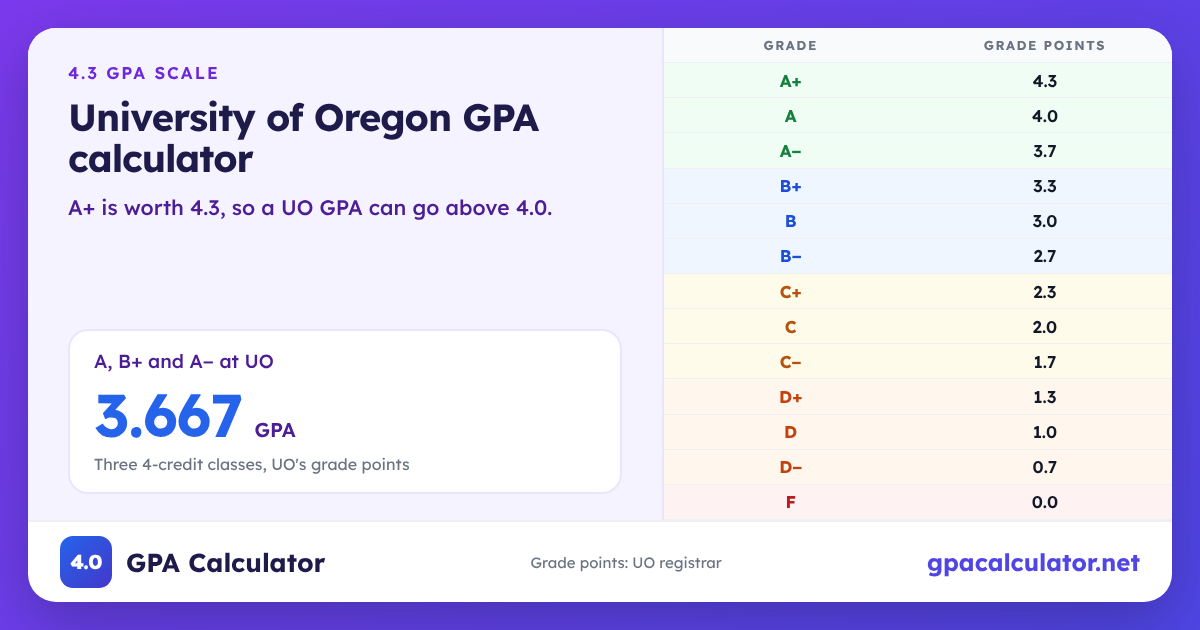
UO assigns quality points to letter grades and weights them by course credits.
| Grade | Grade points |
|---|---|
| A+ | 4.3 |
| A | 4.0 |
| A- | 3.7 |
| B+ | 3.3 |
| B | 3.0 |
| B- | 2.7 |
| C+ | 2.3 |
| C | 2.0 |
| C- | 1.7 |
| D+ | 1.3 |
| D | 1.0 |
| D- | 0.7 |
| F | 0.0 |
UO instructors can add a plus or minus to A, B, C and D grades, and each one moves the grade by 0.3 points. That means an A+ is worth 4.3, so a UO GPA can go above 4.0. An F contributes zero quality points, but its graded credits still count in the GPA denominator.
Which UO Grades Count in GPA?
Grades A through F count in the standard undergraduate GPA. P, N, I, AU, W, X, and the historical Y mark are disregarded in GPA computation.
| Mark | GPA treatment |
|---|---|
| A through F | Included |
| P / N | Excluded from standard undergraduate GPA |
| I | Excluded until resolved to a final grade |
| AU | Excluded |
| W | Excluded |
| X | Excluded until a grade is reported |
| Y | Historical mark; excluded |
A Pass can still carry academic credit even though it does not add quality points to the GPA. GPA treatment, earned credit, academic standing, and financial-aid pace are separate questions.
How UO Calculates GPA
The basic calculation is:
GPA = total quality points ÷ total GPA-bearing credits
For example, a 4-credit A earns 16.0 quality points and a 4-credit B+ earns 13.2. Together, those courses produce 29.2 quality points across 8 credits, for an exact GPA of 3.65.
UO’s official catalog says the GPA is truncated to two digits after the decimal point. This calculator does the same, so it cuts your GPA off after two decimals instead of rounding. A GPA of 3.4999 shows as 3.49.
Repeated Courses at UO
For the current policy, repeating a course does not erase the earlier graded attempt from your GPA. Effective fall 2019, all graded attempts of UO courses are included in term and cumulative GPAs. For a nonrepeatable course, credit is awarded only once even though the graded attempts count in GPA.
Calculator limitation: The Repeat Impact button is not used for UO because the shared repeat tool models grade replacement. For current UO records, enter each graded attempt as its own completed course row.
UO had a different undergraduate repeat calculation from fall 2016 through summer 2019, when the second grade could replace the first in cumulative GPA for qualifying nonrepeatable courses. If your record depends on that historical period, use your official transcript or ask the Registrar rather than applying the current count-all rule retroactively.
Transfer Courses and Your UO GPA
Grades earned at another institution do not enter the University of Oregon institutional GPA. Accepted transfer credit can still satisfy degree requirements, but transfer-credit acceptance and UO GPA inclusion are separate.
UO also calculates a transfer GPA for admission. That admissions GPA can include A–F attempts from prior colleges, including repeated courses, so it should not be confused with the GPA you earn after enrolling at UO.
UO First-Term Grade Forgiveness
UO’s first-term grade-forgiveness policy applies to eligible first-term admitted undergraduates. An eligible F in a course that allows P/N is converted to the P/N grading option, while an eligible D may be changed to P/N by request within the policy deadline.
Because the outcome depends on eligibility, timing, course grading options, and the final record, this calculator does not predict forgiveness. Enter the grade or mark that is actually posted after any approved change.
UO GPA for Academic Standing, Aid, and Honors
These thresholds use different GPA purposes and should not be treated as interchangeable.
| Purpose | Current UO standard |
|---|---|
| Undergraduate good standing | 2.00 or higher term and cumulative UO GPA |
| Undergraduate financial-aid SAP GPA | At least 2.00 cumulative UO GPA, plus pace requirements |
| Most graduate financial-aid SAP GPA | At least 3.00, plus pace requirements |
| Graduate satisfactory academic standing | At least 3.00 cumulative graduate GPA, plus other progress rules |
| Dean’s List | 3.75+ term GPA with at least 12 letter-graded credits |
| Latin honors | Summa 3.95+; magna 3.85–3.94; cum 3.75–3.84, plus eligibility conditions |
A calculator result can help with planning, but it does not determine official standing, aid eligibility, honors, or graduation status.
How the University of Oregon compares: Latin honors GPA at 100 universities.
UO Graduate and Law Grading Differences
Graduate students generally must maintain at least a 3.0 graduate GPA, and graduate P represents work at B- or better. Law has additional grading differences; for example, the Registrar’s grading table notes that an N in law is calculated as F with zero points, unlike the standard undergraduate treatment.
For that reason, this page’s calculator is not presented as a universal graduate or law GPA calculator.
University of Oregon Transfer Admission GPA
For transfer admission consideration, UO currently lists a minimum cumulative transfer GPA of 2.25 for Oregon residents and 2.50 for nonresidents, with a 2.00 standard for applicants holding specified Oregon transfer credentials. UO may recalculate the admission GPA, so it may differ from the GPA printed by a previous college.
University of Oregon admissions & average GPA
University of Oregon GPA FAQs
Does UO have an A+ grade worth more than 4.0?
Yes. A plus adds 0.3 points at UO, and that applies to A as well, so an A+ is worth 4.3. A few A+ grades can lift your GPA above 4.0. The FAQ question ‘Does UO have an A+ grade worth more than 4.0?’ can stay as is.
Does a repeated course replace my old grade at UO?
Not under the current policy. Since fall 2019, all graded UO attempts count in term and cumulative GPA, while credit for a nonrepeatable course is awarded only once.
Do transfer grades count in my University of Oregon GPA?
No. Grades from other institutions do not enter the UO institutional GPA, even when the transfer credit is accepted.
Does a P or N affect my UO GPA?
For the standard undergraduate GPA, P and N are excluded from GPA computation. Graduate and law treatment can differ, so students in those records should use the applicable policy.
Does an F count in GPA at UO?
Yes. An ordinary graded F is worth 0.0 quality points and its graded credits remain in the GPA denominator, unless a separate policy such as eligible first-term grade forgiveness changes the final posted grading option.
Does UO round GPA?
The current catalog states that GPA is truncated at two digits after the decimal point. This calculator follows the same rule and shows two decimals, cut off rather than rounded.
What GPA is needed for good academic standing at UO?
Undergraduates generally need both a term GPA and cumulative UO GPA of at least 2.00 for good standing. Warning, probation, and disqualification rules include additional details, so use the official academic-progress policy for a specific standing decision.
What GPA do graduate students need at UO?
The Division of Graduate Studies requires at least a 3.00 cumulative graduate GPA for satisfactory academic standing, and individual programs may set stricter requirements.
Official University of Oregon Resources
- UO grading system
- Registration and academic policies
- Repeating courses
- First-term grade forgiveness
- Academic progress and standing
- Financial-aid satisfactory academic progress
- Graduate grades and incompletes
- Academic honors
- Transfer student requirements
This University of Oregon GPA calculator is an unofficial planning tool. Always use your official UO academic record and the Registrar, advising, financial-aid, graduate, or law office for decisions about GPA, repeats, standing, aid, honors, graduation, or eligibility.