How your GPA is calculated
Plan your target GPA
See the average you need in your upcoming units to reach your goal.
Try a different average
Keep going
Wrong result or missing a feature? Send feedback
On this page · 8 sections
How UC San Diego (UCSD) calculates GPA
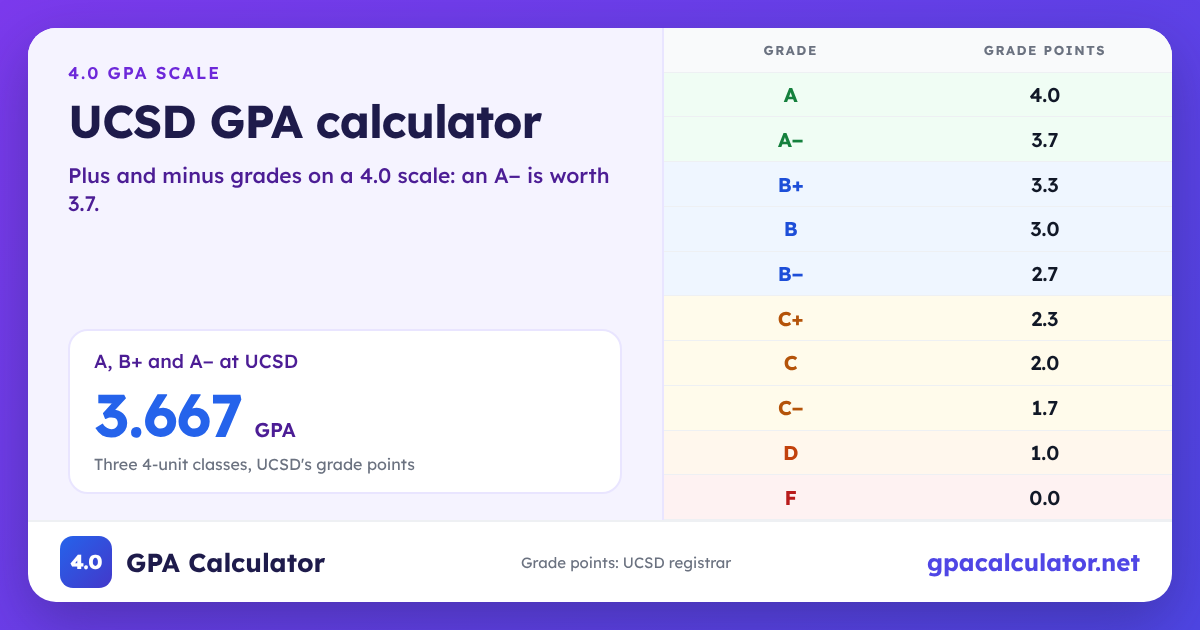
UC San Diego uses a unit-weighted 4.0 GPA. Multiply each GPA-bearing course’s units by its grade-point value, add the grade points, and divide by the total GPA-bearing units.
Quick answer: An A+ does not raise your UCSD GPA above 4.0. A+ and A are both worth 4.0 grade points per unit.
| Grade | Points per unit |
|---|---|
| A+, A | 4.0 |
| A- | 3.7 |
| B+ | 3.3 |
| B | 3.0 |
| B- | 2.7 |
| C+ | 2.3 |
| C | 2.0 |
| C- | 1.7 |
| D | 1.0 |
| F | 0.0 |
For a specific GPA calculation, UC San Diego tells students to use three digits past the decimal point without rounding. Your official cumulative GPA is already shown in Academic History, so use that record when you need the university’s official value. UC San Diego has no D+ or D- grades; D is the only D grade, worth 1.0.
Which grades count in your UCSD GPA?
Letter grades from A+ through F are GPA-bearing. An F contributes zero grade points, but its GPA-bearing units remain in the denominator unless the Registrar later applies an eligible repeat adjustment.
| Grade or notation | GPA treatment |
|---|---|
| A+ through F | Counts using the grade-point table above |
| P / NP | Excluded from GPA |
| S / U | Excluded from GPA |
| I | Excluded while incomplete; later resolution can change the record |
| IP | Excluded until a final grade is recorded |
| W | Excluded from GPA |
| X | Pending notation; wait for the final posted grade |
Important: P/NP can affect degree requirements even though it does not affect GPA. A P generally represents work equivalent to C- or better for undergraduates, but your major or college may restrict where P/NP can be used.
Worked UCSD GPA example
Suppose you take two 4-unit courses and earn an A and a B+. The A produces 16.0 grade points, and the B+ produces 13.2.
GPA = (16.0 + 13.2) ÷ 8 = 3.650
The calculator applies the same unit-weighted method across all GPA-bearing rows you enter.
Do transfer courses count in the UCSD GPA?
The answer depends on where the course was taken. UC San Diego’s Academic Senate GPA rule covers courses taken at University of California campuses, excluding Extension. That means eligible letter grades from another UC campus generally belong in the UC cumulative GPA.
Most coursework transferred from a community college or another non-UC institution can provide degree credit without adding its grade to your UCSD GPA. UC Extension and UC San Diego Extended Studies grades are also outside the UC GPA described by the Senate rule.
Calculator tip: Choose the course source carefully. The UC-course option counts the entered grade; non-UC transfer and Extension options are excluded from the GPA estimate.
How repeated courses affect UCSD GPA
UCSD repeats are not a simple “new grade always replaces old grade” rule. For undergraduates, the first 16 units of eligible repeated courses with an original D, F, or NP generally receive a cumulative-GPA adjustment after the repeat, but there are exceptions. Academic-integrity cases, repeats beyond the limit, course equivalencies, repeatable-for-credit courses, and transcript coding can change the result.
Calculator limitation: Repeat Impact is disabled for UCSD. For an official cumulative GPA after repeating a course, check the repeat code on your Academic History instead of automatically deleting the original attempt.
All attempts remain visible on the transcript. A third or later attempt also requires approval, so repeat eligibility and GPA treatment should be confirmed with your college or the Registrar when the record is unusual. You can repeat a course only if you earned a D, F, NP, U or W. A course you passed with C- or better can’t be repeated.
UCSD GPA requirements for standing and graduation
GPA thresholds depend on the purpose. Do not treat one number as a universal requirement.
| Purpose | Published UCSD standard |
|---|---|
| Undergraduate bachelor’s degree | Cumulative GPA of at least 2.0 |
| Undergraduate academic notice | Term or cumulative GPA below 2.0 |
| Subject to disqualification | Includes term GPA below 1.5, or two successive terms on notice without reaching a 2.0 cumulative GPA |
| Undergraduate financial-aid SAP | 2.0 cumulative GPA plus pace and maximum-timeframe rules |
| Graduate degree / general good standing | Generally 3.0 cumulative GPA, with additional graduate and program rules |
| Provost Honors | 3.5+ UC GPA in at least 12 graded UCSD units for the quarter, with no D, F, or NP |
These thresholds answer different questions. The calculator estimates GPA arithmetic; it does not decide academic standing, financial-aid eligibility, graduation clearance, or honors.
Still in high school? UC admission uses a different GPA: 10th and 11th grade A–G courses, with extra honors points capped at eight semesters. The UC GPA calculator works out that number and shows where it fits at UC San Diego and the other UC campuses.
UCSD Latin Honors and GPA
Latin Honors are percentile-based rather than tied to one permanent GPA cutoff. UC San Diego limits eligibility to the top 14% of graduating seniors and requires at least 72 letter-graded quarter units of University of California coursework.
For Fall 2025 through Summer 2026, UCSD published these ranges: 3.887–3.955 for cum laude, 3.956–3.990 for magna cum laude, and 3.991–4.000 for summa cum laude. The cutoffs change by graduating cohort, so use the current Registrar values rather than treating those numbers as permanent targets.
How UC San Diego compares: Latin honors GPA at 100 universities.
UCSD undergraduate, graduate, and professional-school GPAs
This calculator profile is for the standard undergraduate UC GPA. Graduate students have a separate GPA scope: UCSD calculates the graduate GPA from qualifying upper-division and graduate work taken while in graduate standing, and graduate good-standing rules add requirements beyond the number itself.
The School of Medicine and Skaggs School of Pharmacy use different grading systems for their programs. Do not force those records into this undergraduate 4.0 calculator.
UCSD GPA FAQs
Does an A+ count as 4.3 at UCSD?
No. UC San Diego gives both A+ and A a value of 4.0 grade points per unit. An A+ recognizes extraordinary achievement but does not increase the GPA above the value of an A.
Does P/NP affect my UCSD GPA?
No. P and NP are excluded from grade-point calculations. They can still matter for units, major requirements, repeat eligibility, and other academic rules.
Do community college grades count in my UCSD GPA?
Generally, no. Transferable community college coursework may count toward degree requirements, but its grades normally do not enter the UC cumulative GPA.
Do grades from another UC campus count in my UCSD GPA?
Generally, yes. UCSD’s Senate rule calculates GPA over courses taken at University of California campuses, excluding Extension, so qualifying grades from another UC campus can be part of the UC cumulative GPA.
If I repeat an F, is the original F automatically removed from my GPA?
Not in every situation. The first 16 units of eligible undergraduate D/F/NP repeats generally receive an adjustment, but exceptions and transcript codes matter. Check Academic History after the repeat is graded to see the Registrar’s actual treatment.
What GPA do I need to graduate from UCSD?
Undergraduates need at least a 2.0 cumulative GPA for the bachelor’s degree, along with all other degree requirements. Individual requirements within a curriculum can also apply.
What GPA puts an undergraduate on academic notice?
A term GPA or cumulative GPA below 2.0 can place an undergraduate on academic notice. Subject-to-disqualification rules are separate and include a term GPA below 1.5 or repeated terms on notice without restoring the cumulative GPA to 2.0.
Is the UCSD admissions GPA the same as my UCSD college GPA?
No. Admissions GPA figures describe applicants using admissions-specific calculations and should not be mixed with the enrolled UCSD institutional GPA. For example, the Fall 2026 first-year profile reports a middle-50% GPA range above 4.0, while the enrolled UCSD GPA scale used here tops out at 4.0.
Official UC San Diego Resources
- Academic Senate grading policy
- UC San Diego grading system
- How to calculate a specific GPA
- How to repeat a class
- Academic standing
- Undergraduate financial-aid eligibility
- Latin Honors
This UCSD GPA calculator is a planning tool, not an official university record. Use your UC San Diego Academic History and advising resources for official GPA, repeat coding, standing, degree, aid, and honors decisions.