How your GPA is calculated
Plan your target GPA
See the average you need in your upcoming credits to reach your goal.
Try a different average
Keep going
Wrong result or missing a feature? Send feedback
On this page · 6 sections
How Rutgers calculates GPA
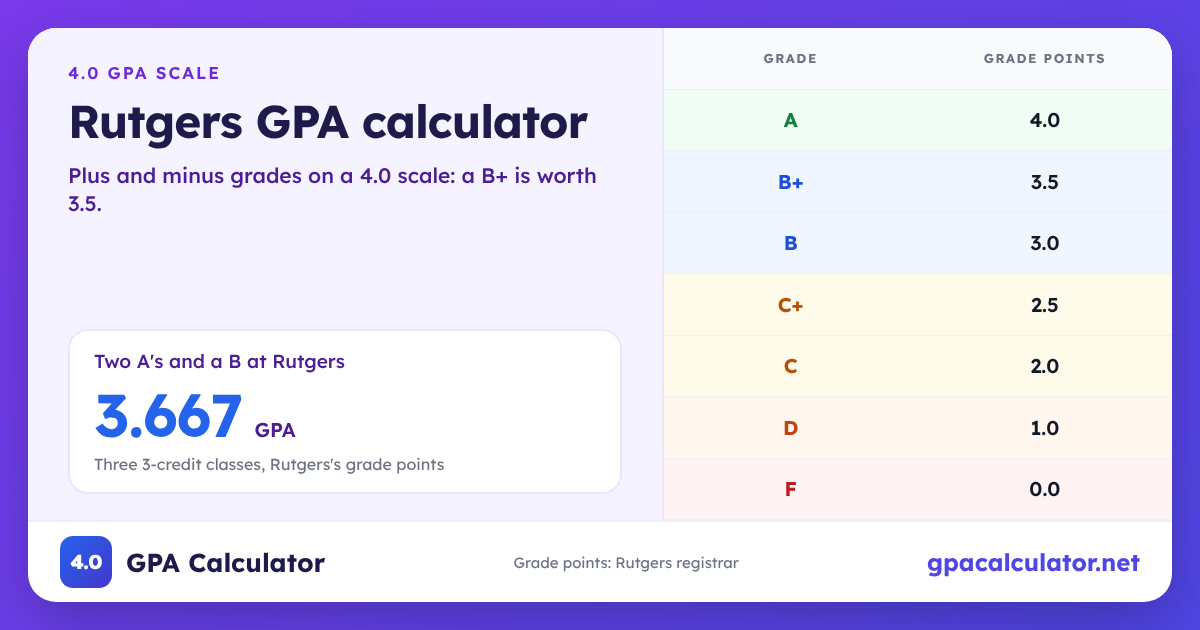
Rutgers-New Brunswick calculates GPA by multiplying each GPA-bearing course’s credits by the grade value, adding those grade points, and dividing by the total GPA-bearing credits.
| Grade | Grade points |
|---|---|
| A | 4.0 |
| B+ | 3.5 |
| B | 3.0 |
| C+ | 2.5 |
| C | 2.0 |
| D | 1.0 |
| F | 0.0 |
Formula: total grade points / total GPA-bearing credits = GPA.
For example, a 3-credit A earns 12 grade points and a 4-credit B+ earns 14. Together, that is 26 grade points across 7 credits, or a 3.714 GPA.
Important: This calculator profile is designed for Rutgers University-New Brunswick School of Arts and Sciences undergraduate GPA planning. Rutgers schools and programs can differ on repeats and other academic policies, so do not apply the SAS repeat rule to every Rutgers program.
Which grades and credits count?
Standard A through F grades count in the GPA. An F contributes zero grade points but its GPA-bearing credits remain in the denominator unless the course later receives an eligible E prefix under the SAS repeat policy.
Pass/No Credit works differently: P earns degree credit but does not enter the GPA, while NC earns no degree credit and does not enter the GPA. An E prefix also removes the course’s grade from the cumulative GPA and provides no degree credit for that attempt. Under Pass/No Credit, you need a C or better to get a P. A D or F becomes NC, so it won’t hurt your GPA, but you also won’t earn credit for the course. Other letters in front of a grade change how it counts. A K prefix means you get no credit but the grade still counts in your GPA. A J prefix means you keep the credit but the grade stays out of your GPA.
Do transfer grades count in the Rutgers GPA?
No. Approved external transfer coursework can provide Rutgers degree credit, but the grades from the outside institution are not included in the Rutgers cumulative GPA. Enter those courses as transfer credit only if you need them in your planning record; do not assign their outside letter grades to the Rutgers GPA calculation. Courses you take at Rutgers-Newark or Rutgers-Camden are not transfer courses. Their grades count in your Rutgers GPA just like New Brunswick courses.
How repeated courses affect GPA in SAS
For eligible School of Arts and Sciences courses, a D or F repeated at Rutgers-New Brunswick can have the original attempt marked with an E prefix. That original grade then stops counting in the cumulative GPA, while the repeated grade counts.
The SAS policy has important limits: it can apply to no more than 16 credits/four courses, only once for a given course, and it does not apply to punitive F grades such as certain academic-integrity sanctions. A repeat taken outside Rutgers-New Brunswick is not eligible for this SAS E-prefix treatment.
Calculator limitation: The Repeat Impact tool estimates one eligible SAS D/F replacement at a time. It does not determine whether you qualify for E-prefix treatment or whether you have already reached the policy limit. Rutgers Business School and other programs can use different repeat rules.
If you earn a D or F again on the repeat, only the second grade counts. Rutgers Business School works differently: when you repeat a business course there, both grades count in your GPA.
Current, projected, and target GPA
To estimate your current cumulative GPA, enter your prior Rutgers GPA and the GPA-bearing credits behind it, then add new completed courses. For a projected GPA, add planned courses with expected grades. The target-GPA tool estimates the average grade-point value you would need over a chosen number of future credits.
If the required future average is above 4.0, the target is not mathematically reachable within the number of credits entered. Increasing the number of future credits may make the target possible, but the calculator does not determine academic eligibility, standing, or graduation timing.
Rutgers GPA requirements students often ask about
For Rutgers-New Brunswick SAS, a bachelor’s degree requires at least a 2.000 cumulative GPA, along with the other degree requirements. SAS considers a fall or spring term GPA of at least 2.000 satisfactory academic progress for its academic-review system, but warning, probation, suspension, and dismissal can involve additional rules.
SAS Dean’s List requires at least a 3.500 term GPA in 12 or more graded credits, excluding Pass/No Credit and E credits. SAS graduation honors use Rutgers cumulative GPA thresholds of 3.500 for cum laude, 3.700 for magna cum laude, and 3.850 for summa cum laude. These are purpose-specific standards, not alternate GPA formulas.
Rutgers admissions & average GPA
Graduation honors
Latin honors at Rutgers–New Brunswick, School of Arts and Sciences: cum laude 3.500, magna cum laude 3.700 and summa cum laude 3.850. GPA isn't rounded; some other Rutgers schools use different cutoffs. Compare Latin honors at 100 universities.
Rutgers GPA Calculator FAQs
Is Rutgers GPA on a 4.0 scale?
Yes. For the standard Rutgers-New Brunswick undergraduate scale, A=4.0, B+=3.5, B=3.0, C+=2.5, C=2.0, D=1.0, and F=0.0.
Does Rutgers use A- or B- grades?
The standard Rutgers-New Brunswick grade table used for this calculator lists A, B+, B, C+, C, D, and F; it does not assign A-, B-, C-, D+, or D- values in this scale.
Does a Rutgers F count in GPA?
Yes. An ordinary F is worth 0.0 grade points and its credits count in the GPA denominator. If an eligible SAS repeat later causes the original course to receive an E prefix, that original attempt is then excluded from the cumulative GPA.
Does Pass/No Credit affect Rutgers GPA?
P and NC do not enter the GPA. P can earn degree credit, while NC does not earn degree credit.
Do transfer grades affect Rutgers GPA?
No. External transfer grades are not included in the Rutgers cumulative GPA, even when the course is accepted for transfer credit.
Does Rutgers replace a repeated D or F?
For eligible SAS undergraduate repeats, the original D or F can be E-prefixed and excluded from the cumulative GPA while the repeated grade counts. Limits and exceptions apply, and other Rutgers schools can use different repeat policies.
What GPA do I need to graduate from Rutgers SAS?
SAS requires a minimum 2.000 cumulative GPA for the bachelor’s degree, in addition to completing the curriculum, credit, and other graduation requirements.
What GPA is needed for the SAS Dean’s List?
The SAS Dean’s List standard is a minimum 3.500 term GPA in at least 12 graded credits, excluding Pass/No Credit and E credits.
Official Rutgers Resources
- Rutgers GPA calculation and grade values
- SAS repeating courses policy
- SAS degree requirements
- SAS academic review and standing
- Rutgers Business School undergraduate policies
- Rutgers transfer information
This Rutgers GPA calculator is an unofficial planning tool. Your Rutgers transcript, school or program policies, and Rutgers advisers or registrar determine your official GPA, repeat treatment, academic standing, honors, and degree eligibility.