How your GPA is calculated
Plan your target GPA
See the average you need in your upcoming credits to reach your goal.
Try a different average
Keep going
Wrong result or missing a feature? Send feedback
On this page · 7 sections
How to Use the Pitt GPA Calculator
Enter your previous Pitt GPA and the credits behind it if you want a cumulative estimate, or leave those fields blank to calculate from the courses you enter. Add each completed Pitt course with its credit value and final grade. Once you have a valid GPA-bearing baseline, you can add planned courses or set a target GPA.
Quick answer: Pitt uses a 4.00 maximum. A+ does not raise the scale above 4.0; both A+ and A are worth 4.00 quality points per credit.
The calculator is designed for Pitt’s general career-level GPA. Individual schools and programs may also use major, program, academic-standing, or professional-school rules that should not be substituted for the general GPA calculation.
Pitt GPA Scale
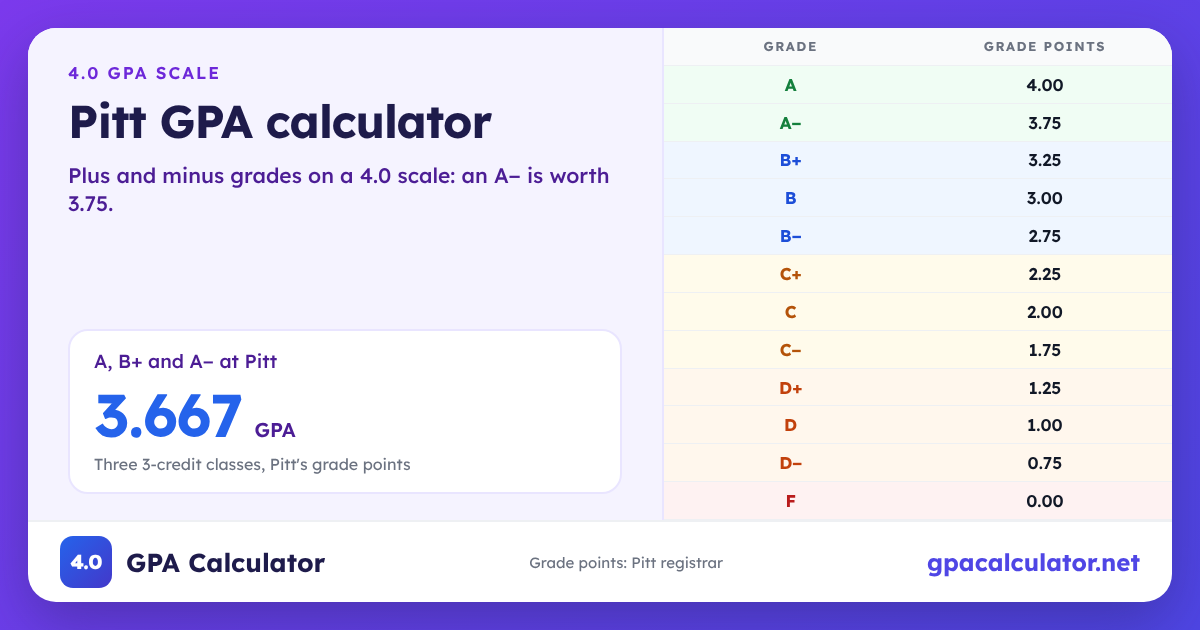
| Grade | Quality points per credit | Counts in GPA? |
|---|---|---|
| A+ | 4.00 | Yes |
| A | 4.00 | Yes |
| A- | 3.75 | Yes |
| B+ | 3.25 | Yes |
| B | 3.00 | Yes |
| B- | 2.75 | Yes |
| C+ | 2.25 | Yes |
| C | 2.00 | Yes |
| C- | 1.75 | Yes |
| D+ | 1.25 | Yes |
| D | 1.00 | Yes |
| D- | 0.75 | Yes |
| F | 0.00 | Yes |
An F is different from a non-GPA grade: an F contributes zero quality points while its GPA-bearing credits remain in the calculation. Pitt’s plus and minus grades are a quarter point apart, not the 0.3 or 0.33 most schools use. An A- is 3.75 at Pitt but 3.7 at many other schools, so a generic GPA calculator will give you a slightly different answer.
Grades That Do Not Add Quality Points to Your Pitt GPA
Pitt also uses grading bases and transcript symbols that do not carry quality points. H and S under H/S/U, S and NC under S/NC, audit N, withdrawal W, resignation R, and unfinished or incomplete symbols such as G and I do not function like a zero-point F in the GPA.
Important: Do not enter S, NC, H, U, W, N, G, or I as if they were F grades. They carry no quality points under the general University grading rules. Some of these grades can still matter for earned credit, degree progress, repeat-attempt limits, or financial-aid pace.
How Pitt Calculates GPA
For letter-graded work, multiply each course’s credits by its grade value to get quality points. Add the quality points, then divide by the total GPA-bearing credits.
GPA = total quality points ÷ total GPA-bearing credits
For example, a 3-credit A earns 12.00 quality points. A 3-credit B+ earns 9.75. Together, the two courses produce 21.75 quality points over 6 credits, for a GPA of 3.625.
Pitt’s transcript reports term and cumulative GPA at the career level. A school may separately track another GPA for a major or program.
Repeating a Course at Pitt
Effective Fall 2025, Pitt limits a course to three total attempts. For GPA purposes, the most recent graded attempt is used and the earlier attempt is excluded from the GPA, although all attempts remain on the transcript. A lower repeat grade can therefore lower your GPA.
The calculator’s Repeat Impact tool is appropriate for a simple same-credit graded replacement. It is not a final eligibility decision for a third attempt, course substitution, petition exception, or a repeat that ends in a non-GPA or unfinished grade.
Important: A later W or other non-GPA result does not simply erase the earlier GPA grade. If your repeat history is more complicated than one completed graded replacement, confirm the record with your school or the University Registrar.
Pitt Transfer Credit and Cross-Registration
Accepted transfer work can apply toward Pitt degree requirements, but transfer units are recorded separately from ordinary Pitt letter-graded coursework. Do not copy an external institution’s letter grade into this calculator as though it were a Pitt GPA grade unless your official Pitt academic record actually treats that course as Pitt GPA-bearing work.
PCHE cross-registration is a separate situation: earned grades and units are transferred to the home institution, while the host institution’s academic policies govern the course. Use the grade and credit treatment shown on your Pitt record when planning your GPA.
Pitt Academic Standing, Graduation, and Financial Aid GPA
A GPA number can have different consequences depending on your school and purpose. For example, Pitt Business publishes a 2.00 overall GPA requirement for the BSBA and a 2.25 major GPA requirement, while Dietrich uses its own Academic Alert, probation, and suspension framework. Dean’s List rules also vary by school.
Financial-aid satisfactory academic progress is separate from academic standing. Under Pitt’s University SAP policy, an undergraduate with 30 or fewer combined Pitt-earned and accepted transfer/advanced-standing credits must have at least a 1.50 cumulative GPA; above 30 credits, the minimum is 2.00. SAP also requires at least 67% pace and compliance with the maximum timeframe.
Calculator limitation: Use the result to plan your GPA, not to decide whether you are officially in good standing, eligible for aid, qualified for honors, or cleared to graduate. Those decisions can depend on your school, credit totals, pace, major GPA, and other requirements.
Graduation honors
Latin honors at the University of Pittsburgh: cum laude 3.25, magna cum laude 3.50 and summa cum laude 3.75. 60 letter-graded credits at Pitt. All your Pitt coursework counts in the GPA. Compare Latin honors at 100 universities.
Pitt GPA Frequently Asked Questions
Is Pitt on a 4.0 GPA scale?
Yes. Pitt’s general letter-grade scale tops out at 4.00, and both A+ and A are worth 4.00 quality points per credit.
What is an A- worth at Pitt?
An A- is worth 3.75 quality points per credit. Pitt’s plus/minus values are not the common 3.7/3.3 pattern: B+ is 3.25, B- is 2.75, C+ is 2.25, and C- is 1.75.
Does an S or NC affect my Pitt GPA?
No. S and NC do not carry quality points and are not computed in the general GPA. An S may still earn course credit, while NC does not earn credit.
Does a U count as a 0.0 like an F?
No. Under Pitt’s H/S/U grading basis, U carries no quality points and is not computed in GPA. An F on the letter-grade basis is a zero-point GPA grade.
How does repeating a class affect my Pitt GPA?
The most recent graded attempt replaces the prior attempt in the GPA, even if the newer grade is worse. The earlier course and grade remain visible on the transcript.
How many times can I attempt the same Pitt course?
Effective Fall 2025, the University generally limits a course to three total attempts. W, G, and I can count toward the attempt limit even though their GPA treatment differs, while audit N and resignation R do not count as attempts under the current repeat FAQ.
Do transfer grades count in my Pitt GPA?
Accepted transfer units can count toward degree requirements, but they are recorded as transfer work rather than ordinary Pitt letter-grade GPA courses. Use your Pitt academic record and your school’s transfer evaluation for the official treatment.
What GPA do I need to stay in good standing at Pitt?
There is no single detailed standing rule that should be applied to every Pitt school. Some schools use a 2.00 cumulative benchmark, while Dietrich and other schools publish their own alert, probation, and suspension processes. Check the rules for your academic center.
What GPA do I need for Pitt financial aid SAP?
For the University SAP GPA test, undergraduates with 30 or fewer combined Pitt-earned and accepted transfer/advanced-standing credits need at least a 1.50 cumulative GPA; students above 30 credits need at least 2.00. GPA is only one part of SAP, which also includes 67% pace and a maximum timeframe.
Official University of Pittsburgh Resources
- University grading regulation and grade values
- Course repeat academic regulation
- Course repeat FAQ
- Student grades and course repeats
- Enrollment, grading options, and auditing
- Information included on Pitt transcripts
- Transcripts and transfer units
- Undergraduate grading regulations
- Pitt Business standards and policies
- Dietrich School academic standing
- University financial-aid satisfactory academic progress policy
- PCHE cross-registration
GPAcalculator.net is independent from the University of Pittsburgh. Calculator results are planning estimates; your official Pitt academic record and current University, school, and program policies control. Confirm repeat eligibility, standing, graduation, honors, and financial-aid decisions with the appropriate Pitt office.