How your GPA is calculated
Plan your target GPA
See the average you need in your upcoming units to reach your goal.
Try a different average
Keep going
Wrong result or missing a feature? Send feedback
On this page · 8 sections
How to Use the MIT GPA Calculator
Enter your previous MIT GPA and previous GPA-bearing units if you already have a cumulative baseline. Then add completed subjects using MIT units and final grades. The calculator can show a current/cumulative estimate, planned-course projection, and target-GPA planning result when the entered record is valid.
Calculator limitation: This profile is for standard upper-level undergraduate MIT GPA work. First-year grading, graduate records, thesis-specific rules, and complex cross-registration require separate review and should not be forced through the standard calculation.
MIT rounds its official GPA to one decimal place, so a 4.75 becomes a 4.8. This calculator rounds the same way, so your result matches the format on your MIT record.
MIT GPA Scale
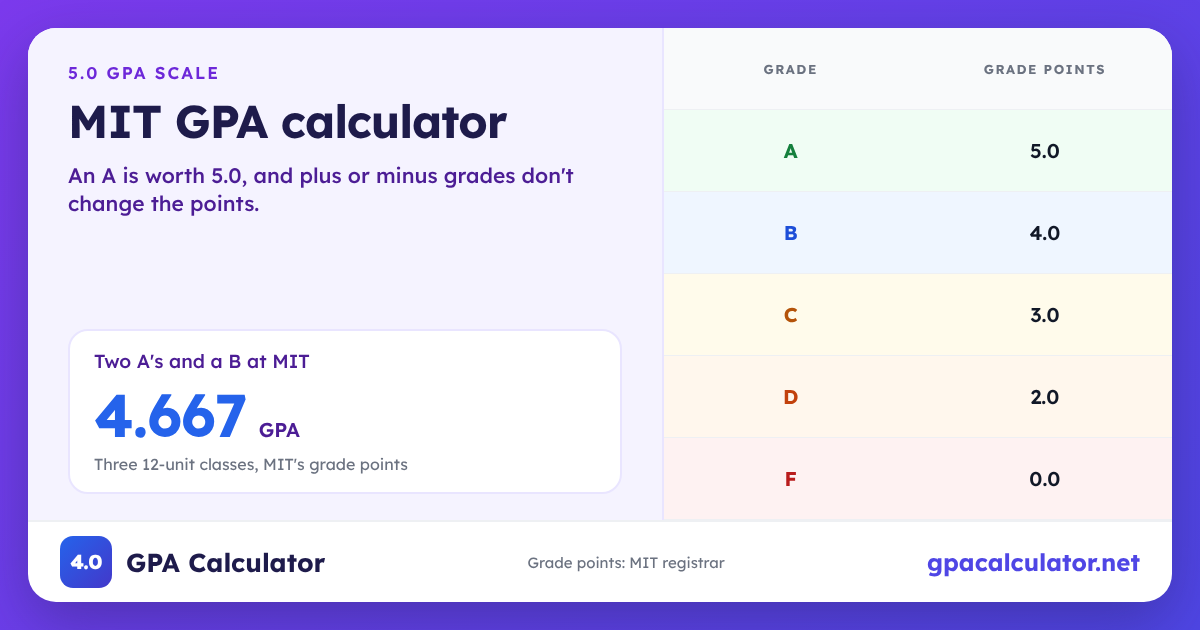
MIT uses a 5.0, unit-weighted GPA system. Plus and minus modifiers may appear internally for A, B, and C grades, but they do not change the GPA value.
| Grade | MIT GPA value | GPA treatment |
|---|---|---|
| A+, A, A- | 5.0 | Counts |
| B+, B, B- | 4.0 | Counts |
| C+, C, C- | 3.0 | Counts |
| D | 2.0 | Counts |
| F | 0.0 | Counts; units remain in GPA |
| O | 0.0 | Counts as zero when it is an ordinary unexcused-absence grade |
| P | — | Excluded from GPA |
| S | — | Excluded from GPA |
| I, OX, J, U | — | Excluded while incomplete or unresolved |
| DN, FN and first-year no-record variants | — | Excluded under the applicable P/NR or first-year rule |
Important: An ordinary F or O is not the same as an excluded no-record mark. F and O contribute zero grade points while their GPA-bearing units remain in the denominator. P, S, and other excluded marks contribute neither GPA points nor GPA units.
How MIT Calculates GPA
MIT calculates GPA by multiplying each GPA-bearing subject’s units by its grade-point value, adding the grade points, and dividing by the total GPA-bearing MIT units.
MIT GPA = total grade points / total GPA-bearing MIT units
Worked example
| Subject result | Units | Grade value | Grade points |
|---|---|---|---|
| A | 12 | 5.0 | 60 |
| B | 12 | 4.0 | 48 |
| Total | 24 | 108 |
108 / 24 = 4.5.
MIT reports the official GPA to one decimal place. MIT reports the official GPA to one decimal place, and the calculator rounds its result the same way. Because MIT rounds to one decimal, a 4.74 shows as 4.7 and a 4.75 shows as 4.8. A small change in one subject can move your reported GPA by a full tenth, or not at all.
MIT First-Year Grading Is Different
First-year students should not treat fall and IAP as ordinary A-F GPA terms. MIT uses Pass/No Record in first-year fall and IAP, and the first official GPA is calculated after the spring term.
First-year spring uses ABC/No Record. Because these rules differ materially from the standard upper-level record, the calculator routes first-year grading to manual review rather than assigning an ordinary upper-level GPA automatically.
Eligible undergraduates may also use Flexible P/NR after the first term. A Flexible P/NR result should be handled according to the official grading option rather than converted into a standard letter-grade GPA entry.
Repeating a Subject at MIT
MIT counts each graded attempt of a repeated subject in the GPA. The later grade does not replace the earlier grade in the ordinary MIT GPA calculation.
Quick answer: Enter both GPA-bearing attempts as separate completed rows. Do not use a grade-replacement calculation. If one attempt is already included in the previous cumulative GPA baseline, do not enter that same attempt again or it will be double-counted.
Degree credit is a separate issue. A repeated subject normally earns degree unit credit only once unless the subject is specifically repeatable for credit.
MIT Transfer Credit and Cross-Registration
Approved external transfer credit recorded as S does not enter the MIT GPA. Transfer-credit acceptance and GPA inclusion are separate questions, so an accepted outside course should not automatically be converted to an MIT letter grade for this calculator.
Cross-registration can be different because MIT may translate an outside grade and convert the course units. Complex cross-registered work is therefore a manual-review case in this profile. Use the posted MIT-equivalent grade and converted MIT units only when the official MIT record supports them. Credit from an Advanced Standing Exam (ASE) and ROTC subjects also stays out of your MIT GPA, even though it can count toward your degree.
MIT Projected and Target GPA Planning
For a projected GPA, add planned MIT subjects with expected grades after you have a valid GPA-bearing baseline. The calculator combines the current GPA-bearing record with the planned units and grade points.
For a target GPA, enter the desired GPA and the number of future MIT units you expect to complete. The calculator estimates the average grade-point value you would need over those future units. If the required average is above MIT’s maximum 5.0 grade-point value, the target is not achievable within the entered number of units.
Because a previously reported MIT GPA may already be rounded to one decimal place, projections that begin from a rounded baseline are planning estimates rather than exact reconstructions of the underlying transcript calculation.
MIT Academic Standing and Financial Aid Use Different GPA Rules
Do not treat every MIT GPA threshold as the same policy. Academic standing, financial-aid satisfactory academic progress, graduate review, admission, and degree progress can use different populations, definitions, and accompanying requirements.
| Purpose | MIT GPA context | Important distinction |
|---|---|---|
| Undergraduate term progress | Term rating above 3.0 is part of the usual minimum record | Unit completion and individual CAP review also matter |
| Undergraduate federal aid SAP | Cumulative MIT GPA of at least 3.0 | Pace and maximum-timeframe requirements also apply |
| Graduate federal aid SAP | Graduate cumulative MIT GPA must exceed 4.0 | Graduate record is separate from this calculator profile |
| Transfer admission | Prior institution record | MIT does not turn this into the enrolled MIT 5.0 GPA |
The calculator should not be used as an official decision tool for standing, graduation, aid, admission, or program eligibility.
Massachusetts Institute of Technology admissions & average GPA
Graduation honors
No graduation honors or class rank. Compare Latin honors at 100 universities.
MIT GPA FAQs
Is MIT GPA out of 4.0 or 5.0?
MIT’s institutional GPA is on a 5.0 scale. MIT also publishes a separate conversion for external 4.0-scale use, but that conversion is not the official enrolled-student MIT GPA.
Is an A- lower than an A for MIT GPA?
No. A+, A, and A- all carry 5.0 grade points per MIT unit. Likewise, B modifiers carry 4.0 and C modifiers carry 3.0.
Does an F count in MIT GPA?
Yes. An ordinary F has a value of 0.0, and its GPA-bearing units remain in the denominator. That is different from an excluded Pass/No Record or other non-GPA notation.
Does Pass/No Record affect MIT GPA?
A P does not enter the GPA, and first-year or Flexible P/NR no-record grades are excluded under their specific grading rules. Do not substitute an ordinary zero-point F for a no-record result.
Does retaking a subject replace the old MIT grade?
No. Both graded attempts normally count in MIT GPA. Enter both counted attempts separately rather than using a replacement calculation.
When do first-year MIT students get a GPA?
The first GPA is calculated after the first-year spring term. Fall and IAP use Pass/No Record and do not produce the standard GPA used by this upper-level calculator profile.
Do transfer grades count in MIT GPA?
Approved external transfer credit recorded as S does not enter MIT GPA. Cross-registration can require an MIT translation and unit conversion, so it should be checked separately.
Why does this calculator show three decimals when MIT shows one?
Question: ‘Does MIT round GPA?’ Answer: Yes. MIT rounds the official GPA to one decimal place, so 4.75 becomes 4.8. This calculator rounds the same way.
Official MIT Resources
- MIT Registrar: Calculating GPA
- MIT Catalog: Academic Performance and Grades
- MIT Registrar: First-Year Grading
- MIT Registrar: Repeating a Subject
- MIT Registrar: Flexible P/NR Grading Option
- MIT Registrar: Transfer Credit
- MIT Registrar: Harvard Cross-Registration Grade Translation
- MIT Registrar: Converting Harvard Units
- MIT Registrar: Undergraduate Degree Requirements
- MIT Advising: Undergraduate Academic Standards
- MIT Admissions: Transfer Applicants
- MIT Admissions: Class Rank and GPA
GPAcalculator.net is independent from the Massachusetts Institute of Technology. Calculator results are planning estimates only; your official MIT academic record and current MIT policies control. Use MIT’s official offices and records for standing, graduation, financial-aid, admission, and other academic decisions.