How your GPA is calculated
Plan your target GPA
See the average you need in your upcoming credits to reach your goal.
Try a different average
Keep going
Wrong result or missing a feature? Send feedback
On this page · 7 sections
How Johns Hopkins Calculates GPA
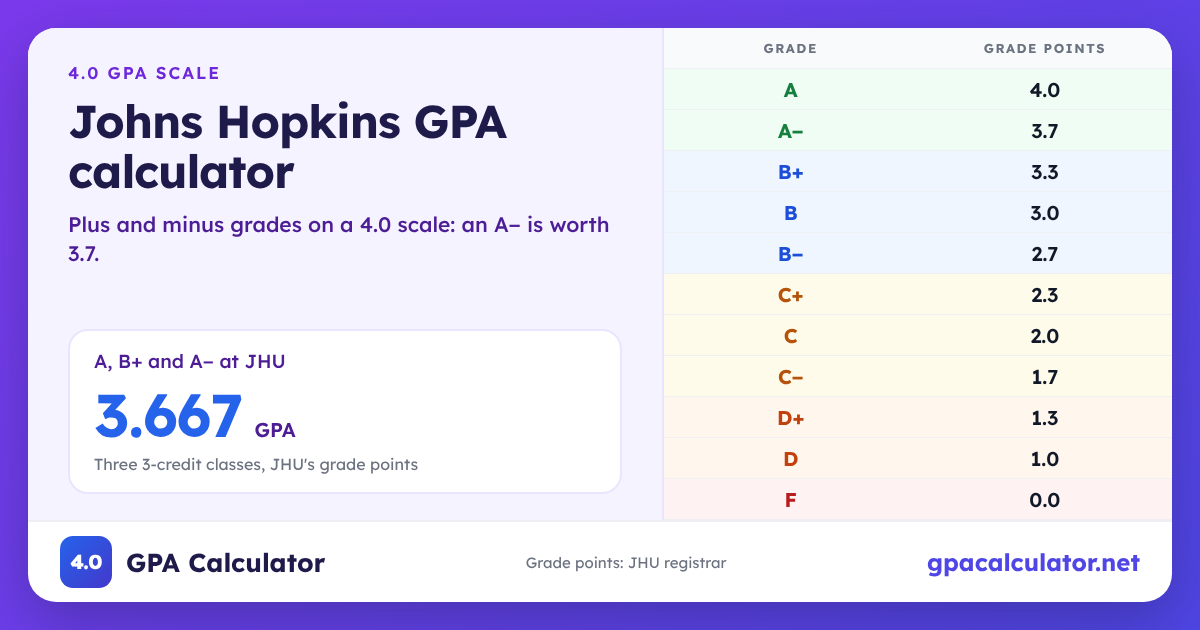
For Homewood undergraduates, multiply each GPA-bearing course’s credits by its grade-point value, add the grade points, and divide by the total GPA-bearing credits.
GPA = total grade points ÷ total GPA-bearing credits
| Grade | GPA points |
|---|---|
| A+ | 4.0 |
| A | 4.0 |
| A- | 3.7 |
| B+ | 3.3 |
| B | 3.0 |
| B- | 2.7 |
| C+ | 2.3 |
| C | 2.0 |
| C- | 1.7 |
| D+ | 1.3 |
| D | 1.0 |
| F | 0.0 |
Quick answer: An A+ does not raise a Johns Hopkins Homewood GPA above 4.0. A+ and A are both worth 4.0 grade points per credit.
Worked example
A 4-credit A earns 16.0 grade points. A 3-credit B+ earns 9.9. Together, 25.9 grade points divided by 7 credits gives a 3.700 GPA. There is no D- at Hopkins. The lowest passing grade is a D, worth 1.0.
Which Grades Count in Your Hopkins GPA?
Satisfactory/Unsatisfactory grades do not affect the Homewood GPA. An S represents satisfactory work in an S/U course, while U is unsatisfactory; neither receives a GPA point value. An incomplete is temporary and does not affect GPA until the final or reversion grade is posted. An official W is also excluded.
| Mark | GPA treatment |
|---|---|
| S | Excluded from GPA |
| U | Excluded from GPA |
| I | Temporary; use the final/reversion grade when posted |
| W | Excluded from GPA |
| F | Counts at 0.0 points with its course credits |
| FEV | Failure associated with an ethics violation; remains GPA-bearing and needs special care for repeats |
Repeating a Course at Johns Hopkins
Homewood undergraduates may use the standard retake policy for a course originally graded C+ or lower. After a completed second attempt, the second grade replaces the original in GPA and credit calculations even if the new grade is lower. The original remains visible on the transcript with an R notation.
Important: If the repeat is dropped or withdrawn, the original grade returns to the GPA calculation. A grade imposed through an adjudicated academic ethics violation cannot be absolved by repeating the course, so do not use the calculator’s Repeat Impact tool for that case.
One course may normally be retaken without written permission. A third attempt or retaking another course requires approval from the appropriate academic advising office, and the repeat normally must be the same Hopkins course.
Do Transfer Grades Count at Johns Hopkins?
Approved external transfer courses can earn Hopkins credit, but the external grades do not appear on the Hopkins record and do not contribute to the Homewood GPA. Enter approved transfer work using the transfer course type so it stays outside the GPA calculation.
Study abroad is more complicated because transcript posting depends on the program and course arrangement. The calculator sends study-abroad and other uncertain external-program cases to manual review rather than guessing. Study abroad depends on who teaches the course. Courses taught by Johns Hopkins faculty post with their grades and count in your GPA. Other study abroad courses post with an SA notation and do not count.
Other Johns Hopkins Schools Use Different GPA Rules
This calculator is for full-time, on-campus KSAS/WSE undergraduates at Homewood. Do not use its 3.7/3.3 Homewood plus/minus values for Peabody, which uses a different plus/minus scale, or assume the same policies apply to Carey, Bloomberg, SAIS, Nursing, Medicine, Education, or graduate programs.
Calculator limitation: If your course belongs to another Johns Hopkins division or your record is not the Homewood undergraduate record, confirm the grading and transcript treatment with your school before calculating.
Johns Hopkins GPA Benchmarks Students Commonly Ask About
These numbers serve different purposes and should not be treated as interchangeable cutoffs.
| Purpose | Current Homewood rule/context |
|---|---|
| Good academic standing | Generally at least 12 earned credits and a term GPA of at least 2.0 each regular semester |
| Major GPA | At least 2.00 in letter-graded courses used for major requirements; programs may add requirements |
| Dean’s List | Term GPA of at least 3.50 with the required credit load and graded credits |
| General Honors | Cumulative GPA of at least 3.50 at conferral |
| Need-based Hopkins scholarship | No continuing GPA requirement stated in the current financial-aid FAQ; federal aid separately requires SAP |
A calculator result can help you plan, but it does not determine academic standing, honors, degree clearance, financial-aid eligibility, or program eligibility by itself.
How to Plan a Target GPA at Johns Hopkins
Enter your current GPA and the GPA-bearing credits behind it, then add completed or planned Homewood courses. The target tool estimates the average you would need over a chosen number of future credits. Because the Homewood scale tops out at 4.0, a required future average above 4.0 means that target cannot be reached within the entered number of credits.
Johns Hopkins admissions & average GPA
Graduation honors
Graduation honors at Johns Hopkins University: general honors 3.50. One honors level; departments also give their own honors. Compare Latin honors at 100 universities.
Johns Hopkins GPA FAQs
Is an A+ worth 4.3 at Johns Hopkins?
No. For Homewood KSAS/WSE undergraduates, both A+ and A are worth 4.0 GPA points per credit.
Does an S grade affect my Johns Hopkins GPA?
No. S and U grades have no effect on the Homewood GPA.
Does an F count in GPA?
Yes. An F is worth 0.0 grade points, but its course credits remain in the GPA denominator unless a valid completed retake later replaces that attempt under the Homewood retake policy.
Can I replace a C+ by retaking the course?
Under the standard Homewood policy, a course with an original grade of C+ or lower may be retaken, and the completed second attempt replaces the original in GPA and credit calculations. Retake limits and approval rules still apply.
What if my repeat grade is lower?
The completed second grade still replaces the original under the standard policy, even if the second grade is lower.
Do transfer grades count in the Hopkins GPA?
No. Approved external transfer grades do not appear on the Hopkins record and do not contribute to the Homewood GPA.
What GPA do I need for Dean’s List?
Homewood undergraduates generally need a term GPA of 3.50 or above in at least 14 credits with at least 12 graded credits. A separate reduced-course-load accommodation rule exists for eligible students.
What GPA is needed for Johns Hopkins General Honors?
General Honors at conferral requires a cumulative GPA of 3.50 or better. Departmental honors have separate program-specific standards.
Is a 3.95 GPA required for admission to Johns Hopkins?
No. The 3.95 figure reported for the Homewood Class of 2029 is an average unweighted high-school GPA for that enrolled class, not a published minimum admission requirement.
Official Johns Hopkins Resources
- Homewood undergraduate grading policies
- Homewood registration and course retake policies
- External transfer credit policies
- Study abroad policies
- Academic standing policies
- Bachelor’s degree requirements
- Graduation policies and General Honors
- Undergraduate admissions
- Financial aid FAQs
This Johns Hopkins GPA calculator is a planning tool for the supported Homewood undergraduate record, not an official university GPA audit or decision about standing, graduation, honors, financial aid, admission, or repeat eligibility. Confirm unusual records and policy exceptions with Johns Hopkins advising or the appropriate registrar.