How your result is calculated
Saved automatically on this device
GPA planner
The average you need next term, and by graduation, to reach a target GPA.
Keep going
Spot a wrong result or want a feature? Tell us. We read every note.
On this page · 5 sections
What a GPA drop calculator shows, and when to use it
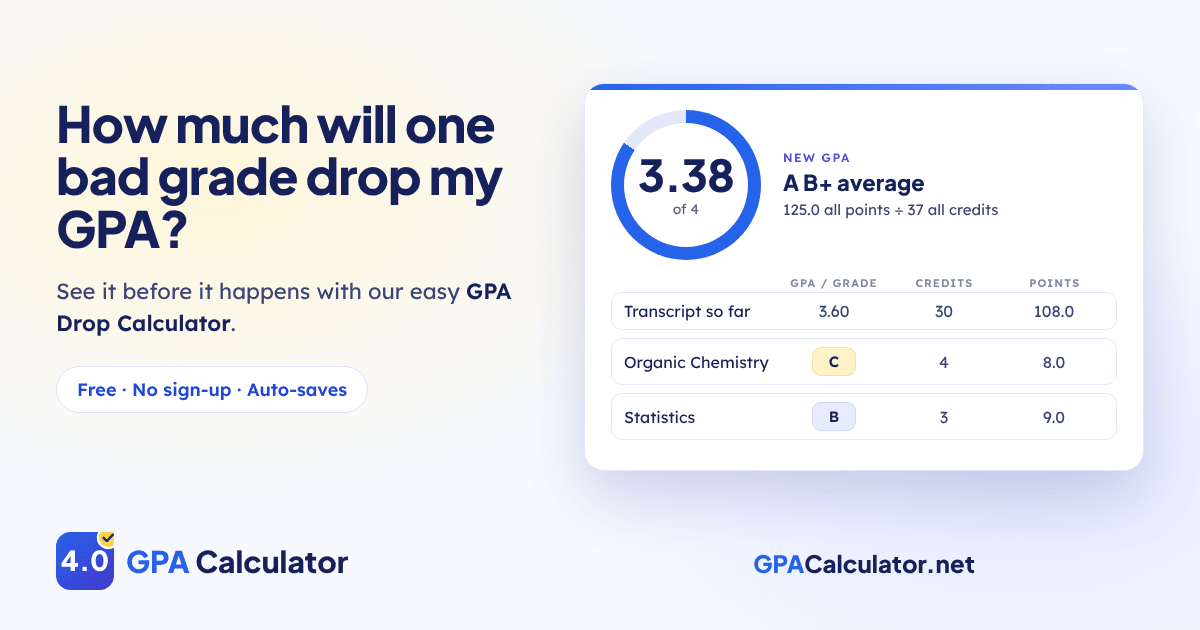
A GPA drop calculator answers one worried question: after a rough term, where does my overall GPA land? You give it the GPA and credits you already have, add this term’s classes, and it shows the new cumulative GPA right away.
Use it when you expect a D or an F, when you’re deciding whether to withdraw from a class, or when your GPA is close to 2.0 and you need to know how far below it you could fall. It doesn’t work out retakes; Plan a retake under the result opens the Course Repeat GPA Calculator for that.
How to use the GPA drop calculator
Enter the GPA you have now
Type your GPA and Credits on the line above the rows. Copy both from your transcript or student portal.
Add this semester’s classes
Pick the Grade you expect (the grade calculator works it out from your scores) and the Credits for each class. Course (optional) is only a label, and + Add class gives you another row.
Compare old and new
Your New cumulative GPA appears as you type, with how far it moved. Try a different grade in one row to see what that class costs.
How much will a D drop my GPA? Formula and example
New GPA = (Old GPA × Old credits + New quality points) ÷ (Old credits + New credits)
Old GPA × Old credits
The quality points already on your transcript.
New quality points
Each new grade’s points times its credits, added up.
New credits
Credits of this term’s graded classes only.
Take a student with a 3.00 over 60 credits who finishes a 15-credit term with two B’s, a C and two D’s, each worth 3 credits. On our standard 4.0 chart a B is 3.0, a C is 2.0 and a D is 1.0; your school sets its own cutoffs.
| Part | Math | Quality points |
|---|---|---|
| GPA so far | 3.00 × 60 credits | 180 |
| Two B’s | 3.0 × 3 × 2 | 18 |
| One C | 2.0 × 3 | 6 |
| Two D’s | 1.0 × 3 × 2 | 6 |
| Total | 75 credits | 210 |
Divide 210 by 75 and the new GPA is 2.80, so the result reads “Down 0.20 from 3.00 — still above 2.0”. The term on its own is a 2.00, yet the 60 earlier credits hold the overall number much higher. Withdrawing from MATH 220, the first of the two D’s, would leave 207 points over 72 credits, a 2.88.
One 3-credit class on that same 3.00 over 60 credits moves it like this.
| Grade in the class | New GPA | Change |
|---|---|---|
| A | 3.05 | +0.05 |
| B | 3.00 | 0.00 |
| C | 2.95 | −0.05 |
| D | 2.90 | −0.10 |
| F | 2.86 | −0.14 |
How to read your new GPA and the 2.0 line
The big number is your new cumulative GPA. The line under it says how far it moved from the GPA you typed and where that leaves you against 2.0; This term is the term on its own.
Next comes the GPA you’d have if you withdrew from your lowest class, shown only when that would raise it. Check your catalog’s withdrawal deadline before you count on it.
Not sure of the grade? The “what each grade would do” list under the result shows your new GPA if your lowest class ends as an A, B, C, D, F or W.
Under 2.0 the line turns red and adds your deficit: double your GPA credits and subtract your quality points. A 1.80 over 30 credits plus an F and two C’s reads “Down 0.11 from 1.80 — still below 2.0, 12 quality points short”. NC State counts a deficit as the hours of B grades needed to reach 2.0, so that’s 12 credits of B’s or 6 of A’s.
Plan getting back above 2.0 shows that about a B average (2.80) over the next 15 credits closes it. Change Target GPA, or add Credits left to see the average you need by graduation.
What makes your GPA drop more or less
Credits behind you. The same 3-credit F takes a 3.00 over 30 credits to 2.73, but a 3.00 over 90 credits only to 2.90. Early grades swing a GPA hard; senior-year grades barely nudge it.
How far the grade sits below your GPA. A grade only lowers your GPA if its points are below your current average. A B leaves a 3.00 untouched, and on a 3.50 it costs just 0.02 for a 3-credit class.
Credits of the class. A 4-credit lab counts a third more than a 3-credit lecture with the same grade.
A deep hole can outlast one term. At 1.20 over 90 credits with two F’s, the GPA falls to 1.13, 84 points short of 2.0. Straight A’s over 15 credits only reach 1.51; it takes about 42 credits of A’s.
Withdrawals and repeats. A W adds no credits or points here. How a retake counts depends on your school: Boise State, for one, counts only the most recent grade in most courses.
Financial aid. Federal aid rules need at least a C average (2.0) by the end of your second year, and schools also track the pace of credits you complete. A W can protect your GPA yet hurt that pace, so ask your aid office first.
Frequently asked questions
How much will an F drop my GPA?
It depends on your credits so far and the class’s credits. A 3-credit F takes a 3.00 over 60 credits down to 2.86, and the same F on a 3.00 over 30 credits lands at 2.73.
Will a B drop my GPA?
Only if your GPA is above 3.0, because a B is worth 3.0 points. On a 3.50 over 60 credits, a 3-credit B gives 219 points over 63 credits, a 3.48.
Does dropping a class affect your GPA?
In this calculator a W adds no credits and no points, so your GPA stays where it was. Check your school’s catalog for the drop deadline and for what a late withdrawal turns into.
What is a GPA deficit?
It is how many quality points you are short of a 2.0: two times your GPA credits minus your quality points. NC State calls this a grade point deficit and counts it as the hours of B grades you need to get back to 2.0. The Raise GPA Calculator shows how many terms that takes.
Why did my GPA go down if I got all A’s?
An A− is worth 3.7 on a plus/minus scale, so it pulls down any GPA above 3.7. A 3.90 over 30 credits plus 15 credits of A− lands at 3.83, because 172.5 points over 45 credits is 3.833.
Sources
- Grade Point DeficitNC State University Student Services Center · ncsu.edu
- Course Repetition — GPA Relationship (Policy 3190)Boise State University · boisestate.edu
- 34 CFR 668.34, Satisfactory academic progressLegal Information Institute, Cornell Law School · cornell.edu