Calculate your GPA instantly using letter grades and credit hours on the 4.0 scale. Enter each course to see your semester and cumulative GPA update in real time. Updated for 2026.
How to calculate GPA
(Step-by-step with GPA Calculator)
1. Add Your Letter Grade
Choose the letter grade you earned for each class (A–F, plus or minus). These grades are what the calculator uses to figure out your GPA.

2. Add Your Class Credits
Enter how many credits the class is worth. Most college classes are 3–4 credits, but labs or electives might be 1–2. Add as many classes or semesters as you need.
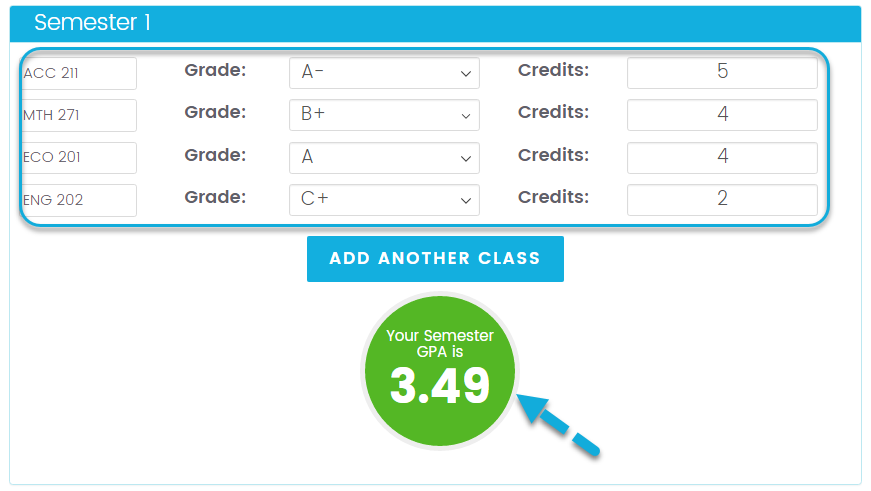
3. Calculate Your GPA
Your semester and cumulative GPA update automatically as soon as you enter your grades and credits. Add more semesters anytime to track your full college GPA.
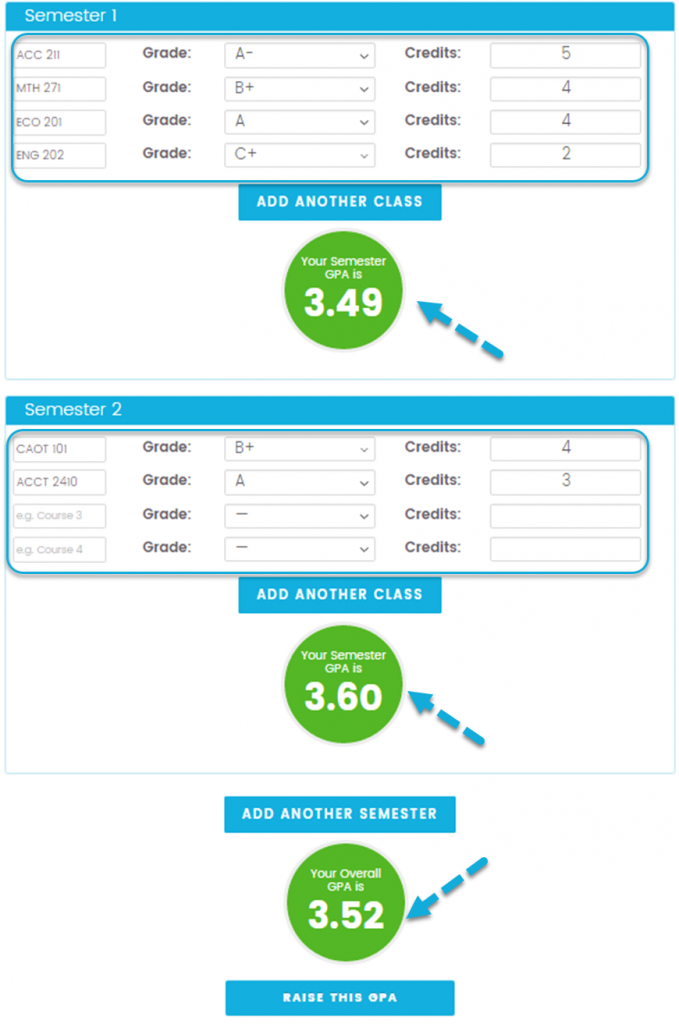
Sample GPA Calculation
Here’s an example of how GPA is calculated using the same grades and credits:
| Course | Grade | Credits |
|---|---|---|
| ENG 101 | A | 3 |
| MATH 121 | B+ | 4 |
| PSY 201 | A– | 3 |
| BIO 110 | C+ | 2 |
After entering these classes into the calculator, your GPA appears instantly:
⭐ Semester GPA: 3.41
If you add previous semesters (GPA + total credits), the calculator also shows your updated cumulative GPA automatically.
GPA Calculation Formula
Colleges calculate GPA using this standard formula:
GPA = Total Quality Points ÷ Total Credit Hours
Where:
- Grade Points = numeric value of your letter grade
- Quality Points = Grade Points × Credits
- Credit Hours = credits for each class
Using the sample semester above:
| Course | Credits | Grade | Grade Points | Quality Points |
|---|---|---|---|---|
| ENG 101 | 3 | A | 4.0 | 12.0 |
| MATH 121 | 4 | B+ | 3.3 | 13.2 |
| PSY 201 | 3 | A– | 3.7 | 11.1 |
| BIO 110 | 2 | C+ | 2.3 | 4.6 |
| Total | 12 | — | — | 40.9 |
⭐ GPA = 40.9 ÷ 12 = 3.41
Your GPA calculator performs all these steps automatically.
4.0 GPA Scale
Most U.S. colleges use the 4.0 GPA scale to assign grade points to letter grades. Some schools include A+ or use slightly different values, but the chart below shows the most common scale. Your GPA is calculated by multiplying these grade points by your course credits.
Why the GPA scale matters:
Your letter grades turn into grade points using this scale. Those points are multiplied by your course credits and used to calculate GPA.
| GPA | Letter Grade | Percent Range |
|---|---|---|
| 4.0 | A | 93–100% |
| 3.7 | A– | 90–92% |
| 3.3 | B+ | 87–89% |
| 3.0 | B | 83–86% |
| 2.7 | B– | 80–82% |
| 2.3 | C+ | 77–79% |
| 2.0 | C | 73–76% |
| 1.7 | C– | 70–72% |
| 1.3 | D+ | 67–69% |
| 1.0 | D | 65–66% |
| 0.7 | D– | 60–64% |
| 0.0 | F | Below 60% |
Note: Some colleges use a 4.33 GPA scale where A+ = 4.33. For details, see the full GPA Scale Guide.
What Your GPA Means
Your GPA doesn’t just reflect your grades – it shapes what opportunities are available to you. Here’s what different GPA ranges typically mean in college:
| GPA Range | What It Means |
|---|---|
| 3.7–4.0 | Excellent — competitive for honors programs, selective majors, internships, and many graduate schools. |
| 3.3–3.6 | Strong — above average; meets requirements for most majors and keeps you in good academic standing. |
| 3.0–3.2 | Good — solid academic performance; satisfies most graduation requirements and upper-division major prerequisites. |
| 2.5–2.9 | Needs improvement — may limit options for competitive programs; raising your GPA will open more opportunities. |
| Below 2.5 | At-risk — may trigger academic probation depending on the school; meeting with an academic advisor can help you make a plan to improve. |
GPA Exceptions
Not every class affects your GPA the same way. Here are the most common exceptions students run into:
| Grade Type | How It Affects GPA |
|---|---|
| Pass/Fail classes | A Pass (P) gives credit but does not affect GPA. A Fail (F/NP) counts as 0.0 and lowers GPA. |
| Withdrawals (W) | A “W” does not affect GPA. A “WF” (Withdraw–Fail) may count as an F depending on your college. |
| Incompletes (I) | Not included in GPA until the final grade is submitted. |
| Retaken courses | Some colleges replace the old grade; others average both attempts. Check your catalog. |
| Transfer credits | Count toward degree progress, but typically not toward institutional GPA. |
GPA policies vary by institution. Always check your college’s catalog for official grade scales, repeat rules, and credit policies.
GPA Calculator – FAQs
What is the difference between semester GPA and cumulative GPA?
Semester GPA reflects your performance in one term only. Cumulative GPA includes all completed semesters and is the number colleges rely on for academic standing, major eligibility, honors, and graduation requirements.
What is the difference between weighted GPA and unweighted GPA?
An unweighted GPA uses the standard 4.0 scale. A weighted GPA rewards tougher courses like Honors or AP by giving extra points – for example, an A in an AP class can count as 5.0 instead of 4.0.
What are credit hours in GPA calculation?
Credit hours show how much a class is worth. A 4-credit course carries more weight in your GPA than a 1-credit elective, so the grade you earn matters more.
What are quality points in GPA?
Quality points are calculated as grade points × credit hours. For example, a B (3.0) in a 4-credit class equals 12 quality points. Adding all quality points together lets you find your GPA.
What is considered a good GPA in college?
A ‘good’ GPA depends on your major and goals, but many colleges consider 3.0 the baseline for good academic standing, 3.5+ competitive for scholarships, and 3.7+ strong for graduate programs.
How can I raise my GPA quickly?
Focus on earning A’s in high-credit classes, retake courses with low grades if possible, and stay organized with consistent study habits. You can also try our Raise GPA Calculator to see how future grades might boost your GPA.
What GPA is required for Dean’s List or academic probation?
Most schools set the Dean’s List cutoff at around 3.5 GPA. Academic probation usually begins when your GPA drops below 2.0, though policies differ by college.
Can I round up my GPA?
Many schools allow rounding to the nearest tenth (for example, 3.48 → 3.5). However, rounding up to a whole number (2.81 → 3.0) usually isn’t permitted.
Does pass/fail affect GPA?
Pass/fail courses typically don’t impact GPA. A passing grade adds credits toward graduation, but it doesn’t raise or lower GPA. A failing grade, though, is usually counted as 0.0.
Do withdrawals affect GPA?
A standard withdrawal (W) won’t change your GPA. But a withdrawal-fail (WF) may count as an F, depending on your school’s grading rules.
Related GPA Calculators
Explore more free GPA tools to calculate grades in different ways and improve academic planning:
- High School GPA Calculator – figure out GPA for high school courses on the 4.0 scale.
- Raise GPA Calculator – see how new grades can improve your current GPA.
- Grade Calculator – calculate course grades with weighted categories.
- Final Grade Calculator – find the score needed on your final exam.