A 4.0 GPA usually means straight A’s on an unweighted 4-point scale. It’s the benchmark many students aim for because it signals consistent top performance across classes. On a weighted scale (where AP/IB/Honors carry extra points), 4.0 might not be “perfect”—you can go higher (4.3, 4.5, even 5.0) depending on your school’s policy.
- A 4.0 GPA equals an A average on the standard 4.0 scale — it’s the highest possible grade at most schools.
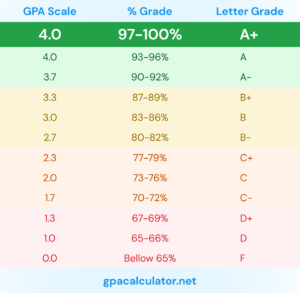
- In percentage terms, a 4.0 typically represents a 93–95% average across all courses.
- The national GPA average is around 3.0, so maintaining a 4.0 places you well above average and among top-performing students.
What Does a 4.0 GPA Mean for High School Students
A 4.0 GPA in high school shows that you’ve earned straight A’s across all subjects. It’s a strong signal to college admissions officers that you are consistent, responsible, and academically driven.
Why it matters:
- Increases eligibility for competitive universities and academic scholarships
- Improves chances for merit-based financial aid
- Demonstrates strong time management and focus
- Strengthens your college application essays and recommendations
But remember:
Colleges also look at course rigor. A 4.0 in easy classes may be less impressive than a 3.8 in challenging AP or IB courses.
What a 4.0 GPA Means for College Students
In college, a 4.0 GPA signals academic mastery within your major or across your program. It’s often used as a criterion for:
- Dean’s List or President’s List
- Honors programs and scholarships
- Graduate school admissions
- Internship or job eligibility (especially for competitive roles)
Most employers won’t expect a 4.0, but maintaining a 3.8–4.0 range keeps you in the top academic bracket and shows diligence.
How to Get a 4.0 GPA
Earning a 4.0 GPA isn’t about being the smartest person in the room — it’s about being strategic, consistent, and knowing how to play the academic game well. You don’t need all-night study sessions or a color-coded planner (though that helps). You need a system that works for you.
1. Treat each semester like a marathon, not a sprint
Getting a 4.0 means thinking long-term. One bad quiz won’t destroy you, but a pattern of last-minute work will. Start assignments early, plan exams backward, and give yourself breathing room to revise.
2. Focus on high-weight assignments first
Most classes don’t grade everything equally. Know which items carry the most weight — midterms, finals, essays — and give them priority. A perfect score on a 5% quiz won’t save you from a mediocre final.
3. Know your teachers’ “style”
Every professor or teacher has tells — what they emphasize, what they reward, and what they ignore. Pay attention to past exams, rubrics, and examples they share in class. That’s where the A’s hide.
4. Learn how you actually learn
Some students memorize fast but forget quickly. Others need repetition. Figure out your rhythm: visual (diagrams, flashcards), auditory (recorded lectures), or kinesthetic (practice problems). Once you know your style, study time becomes efficient instead of endless.
5. Don’t study harder — study deliberately
Re-reading notes doesn’t count as studying.
- Quiz yourself with active recall.
- Space your reviews (spaced repetition).
- Teach the material to someone else — it locks in memory better than anything else.
6. Protect your energy
Burnout kills GPAs faster than any hard exam. You can’t think clearly on three hours of sleep or while running on caffeine and anxiety. Sleep, eat real food, and give your brain downtime. That’s not laziness — it’s maintenance.
How to Maintain a 4.0 GPA
Reaching 4.0 is tough. Keeping it semester after semester is tougher. Grades don’t slip overnight — they slide slowly when you stop tracking, assume you’re fine, or overload yourself.
Here’s how to stay at the top without driving yourself into the ground.
1. Audit yourself weekly
Spend 10 minutes every Sunday checking where you stand in each class. Write down your current averages, upcoming due dates, and missing assignments. Spotting a dip early is what keeps A’s from turning into A–’s.
2. Build “academic buffers”
Do your best work early in the term — before fatigue and finals hit. That early A can absorb small errors later. Think of it as GPA insurance.
3. Don’t let ego pick your classes
Ambition is good, but balance matters. Mix rigorous classes with a few you know you’ll handle easily. A 4.0 student doesn’t chase difficulty; they manage momentum.
4. Talk to professors like teammates, not judges
When you hit a rough patch, email them early. Ask, “Can I improve my next paper by focusing on X?” rather than “Can I get extra credit?” That shows responsibility — and professors remember it.
5. Use breaks strategically
Breaks aren’t wasted time — they’re how your brain consolidates what you’ve learned. Study in focused 50–90 minute sessions, then step away. Long, uninterrupted grinds often lead to worse recall.
6. Accept that a 4.0 doesn’t mean perfection
Sometimes a professor grades harshly. Sometimes life happens. What defines a top student isn’t an unbroken streak of A’s — it’s the ability to adapt fast and stay calm when things wobble.
Frequently asked questions
What does a 4.0 GPA mean?
A 4.0 GPA represents a perfect A average on the standard 4.0 scale. It means you’ve earned straight A’s across all your classes. In percentage terms, it’s typically equal to 93–95%, depending on your school’s grading policy.
Is a 4.0 GPA good?
Yes — a 4.0 GPA is excellent and well above the national average of 3.0. It places you in the top 10–15% of students nationwide and is highly competitive for college admissions, scholarships, and honors programs.
Is it possible to get higher than a 4.0 GPA?
Yes. Some schools use a weighted GPA scale, which gives extra points for advanced courses. For example, an A in an AP or IB class might count as 5.0 instead of 4.0. On weighted scales, you can earn above 4.0.
What percentage is equal to a 4.0 GPA?
A 4.0 GPA usually equals a 93–95% average. However, some schools may define it differently — for example, 90–100% might count as a 4.0 at one school but 94–100% at another. Always check your school’s grading chart.
How hard is it to get a 4.0 GPA?
It takes consistency, organization, and effective study habits. To earn a 4.0, you need to score A’s in all your classes each term. Time management, prioritizing major assignments, and avoiding procrastination are key to sustaining it.
Is a 4.0 GPA required for Ivy League or top universities?
No. Many students admitted to Ivy League or top-tier universities have GPAs between 3.8–4.0. Admissions teams also consider course rigor, essays, recommendations, and extracurricular impact — not just GPA.
Does a 4.0 GPA guarantee scholarships?
Not automatically, but it helps significantly. A 4.0 GPA makes you eligible for academic merit scholarships, especially when combined with strong SAT/ACT scores, leadership experience, and community involvement.
How do colleges calculate GPA?
Most colleges use a weighted 4.0 scale and recalculate your GPA to make comparisons fair across different high schools. They may include only core subjects (math, science, English, social studies, foreign language) and ignore electives.
What happens if I get one B? Does it ruin my 4.0 GPA?
One B in a 4-credit class can lower your GPA below 4.0, depending on how many total credits you’ve completed. However, if your school rounds to one decimal place, a few A+ grades can offset a single B. Always calculate your weighted average to see the exact impact.
What’s a good GPA if I can’t get 4.0?
A 3.7–3.9 GPA is still excellent and competitive for most top colleges. Many honors programs, scholarships, and employers consider anything above 3.5 to be a strong academic record.
Is 4.0 GPA rare?
Yes. Fewer than 10% of students graduate high school or college with a perfect 4.0 GPA. It’s an achievement that shows dedication and consistent excellence over time.
Your Admission Chances With a 4.0 GPA
Without mincing words, knowing whether you will gain admission to your school of choice is a million dollar question that is on the mind of every student seeking admission. Which colleges will offer you admission with a 4.0 GPA? Do you have any chance of securing admission at your schools of preference?
Using these questions, we have created a custom admissions calculator designed to calculate your prospects of admission to your college of choice based on three crucial factors:
- The acceptance rate of the school
- The GPA of the applicant
- Your ACT/SAT score